Theia is the common name for this protoplanet. It was named after the Greek mythological Titan, who also happened to be Selene, the goddess associated with the Moon. According to modern theories on planetary formation, Theia is one of a number of Mars-sized bodies that were present in the Solar System around 4.5 billion years ago.
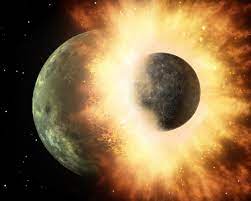
According to the hypothesis of the giant impact (also called the Theia Impact), Theia hit the Earth while the solar system was young. The collision that followed led to fragmentation and extensive intermixing of both parent bodies, resulting in a significant piece breaking off, which gave rise to the Moon.
A study published in Nature revealed that seismic images of Earth’s interior showed two large low-velocity regions (LLVPs) located in the mantle’s lowermost layer.
Researchers believe that these anomalies are traces of Theia Mantle Material (TMM), which is 2,0-3,5% denser in comparison to Earth’s solid lower mantle. The TMM settled to the bottom of Earth’s solid mantle, forming blobs that are 2,900 km (1,800 mi) below Earth’s surface.
The study also suggests that the collision and the debris it left behind may have helped shape the Earth as a planet capable of supporting life.
The study’s authors state: “New computer modeling supports a dramatic story of the origins of these strange blobs. They are artifacts from a massive collision that occurred 4.5 billion years ago between an early Earth and a young planet. The modeling suggests that the violent collision caused material from Theia to embed in the lower half of Earth’s mantle. The crash caused Theia remnants to be launched into orbit, which eventually coalesced in the Moon.