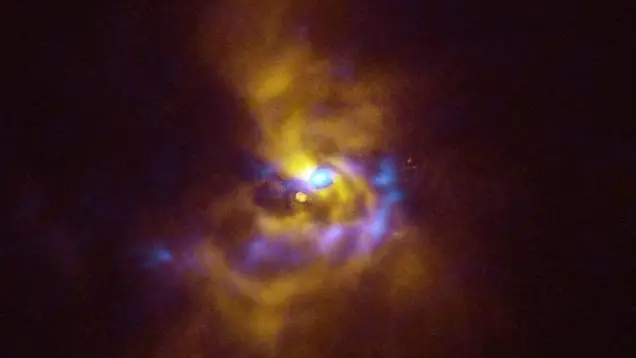
A remarkable image of an ancient star system has given researchers new insight into the formation of gas giants such as Jupiter.
V960 Mon is the star at the center of the system. It’s a young, bright star located about 5,000 light-years away in Monoceros’s constellation. In 2014, the star’s brightness increased to 20 times the average, allowing researchers to use SPHERE (Spectro-Polarimetric High-contrast Exoplanet Research Instrument) from the European Southern Observatory to take images. The research team published a paper in The Astrophysical Journal Letters describing their findings today.
In an ESO press release, a Santiago University astronomer, Sebastian Perez, said: “Our group has searched for signs of planet formation for more than ten years and we could not be happier about this incredible find.”
The SPHERE observations revealed that material around V960 Mon had spiral arms that stretched farther than our solar system.
Follow-up observations of the distant star system were made with the Atacama Large Millimeter/submillimeter Array (ALMA), which penetrated deeper into the dusty material surrounding the star.
In the same press release, Alice Zurlo said, “With ALMA it became evident that the spiral arms were undergoing fragmentation resulting in clumps of masses similar to those of planets.”
Images support a theory about how gas giants are formed: by the material surrounding a sun clumping together, a method of formation known as gravitational instabilities. According to gravitational instability, material clumps contract and collapse forming gassy worlds. This differs from the most common theory of gas giant formation called core accretion, in which dust grains slowly come together to create these large worlds.
The V960 system provides a closer look at the possible formation of these exoplanets.
Researchers hope to understand the chemical compositions of the clumps surrounding such star systems. This will help them determine what type of planets could form.
More observations of V960 and similar systems will continue to improve the understanding of astronomers on how planets such as those in our solar system are formed. In 2027, the Extremely Large Telescope will replace the ESO’s Very Large Telescope.
The Extremely Large Telescope is the largest visible-light and infrared-light telescope in the entire world. It will concentrate its research on exoplanets, black holes, galactic evolution, and the earliest days of the universe.