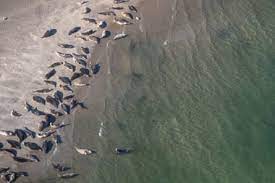
Seals are socially distant, according to aerial surveys in the North Sea. This discovery could have a profound impact on the spread of disease.
Researchers conducting censuses on grey and harbor seals have published an article in the Royal Society today. They detail new evidence showing that these two species do not only keep distance between themselves (unlike the walruses who tend to cluster together) but that their behavior could “reflect an evolution response to viral susceptibility.”
Jeroen HOEKENDIJK, the study’s lead author, told The Guardian, “by comparing harbor seal colonies to grey seal colonies, we found that harbors seals keep more distance from their neighbors than grey seals.” The new report could have significant implications for tracking such outbreaks, especially with the current concern about diseases among wildlife.
The area studied was a vast expanse of wild land on the Dutch Wadden Sea coast, where seals of both species “haul out” to the beaches and intertidal areas for resting, socializing, mating, and giving birth. The seals gather in large numbers. Grey seals can be found in large numbers on the high sandbanks. Harbor seals, which number around 8,000, prefer low-tide sandbanks.
In the past, harbor seals were plagued by devastating outbreaks of disease. The phocine (seal distemper) virus decimated the population in 1988 and 2002. Around 18,000 harbor seals perished from distemper in Europe and the UK 1988. Grey seals were relatively unaffected.
Hoekendijk said that many grey seals had also been infected but did not get sick as much as harbor seals. This contributed to the spreading of the virus. The greys can still move freely, even though they carry the virus. He cited new evidence indicating that the reduced susceptibility of the greys was genetic.
It’s fascinating to think that the social distance described in the report could be a memory from those severe outbreaks. Hoekendijk said that other studies had shown grey seals more resistant to respiratory viruses than harbors seals. The greater distances between harbor seals and other animals we observed in our study could be a reaction… similar to what we did during the Covid Pandemic.
Comparisons to Covid are instructive. Covid itself is a zoonotic virus. This means that it is transmissible between animals and humans. According to a report published earlier this year, Covid is much more prevalent than previously thought. Covid is believed to have also affected marine mammals. There are concerns that human sewage released into the ocean could spread Covid to seals and whales.
Lockdowns have had positive effects on the environment. The lockdown reduced disturbance in wild areas, as seals are susceptible to human interference. Seas were quieter due to the absence of vessels . This created a short window for marine mammals. The lockdowns stopped seal culling in Namibia.
Seals are not the only animals that should be kept at a distance. The bites can cause various problems, including the “seal fingers” caused by the seals’ teeth or claws. These bites can also transmit the bacteria Mycoplasma Phocacerebrale. Infections can lead to the removal of human digits when the skin breaks.