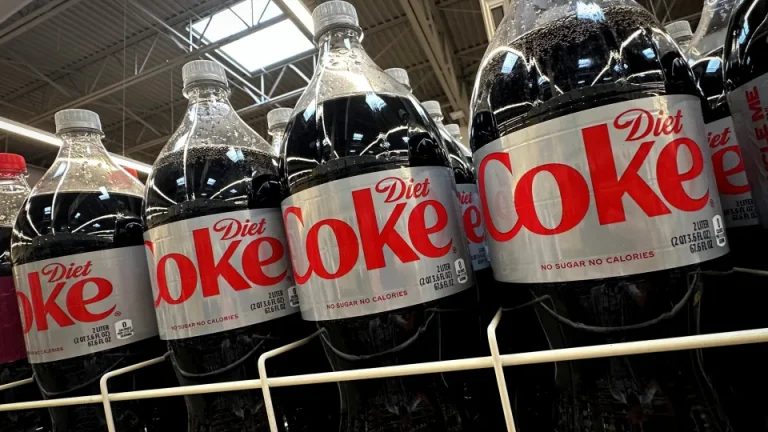
Two sources familiar with the process say that a significant global health organization will declare one of the most popular artificial sweeteners a potential carcinogen. This will pit the food industry against regulators and the FDA.
The sources said that the International Agency for Research on Cancer (WHO’s cancer research arm) would list Aspartame in July for the first time as “possibly a carcinogen to humans.”
The IARC’s ruling, finalized this month following a meeting with the group’s outside experts, is meant to assess whether or not something is a possible hazard based on all published evidence.
This does not consider how much a product can be consumed safely by a person. The advice is based on the findings of a WHO expert committee on additives (JECFA, Joint WHO and Food and Agriculture Organisation Expert Committee on Food Additives) and national regulators.
Similar IARC rulings for other substances in the past have led to concerns from consumers about their use. They also caused lawsuits and pushed manufacturers to change recipes or switch to alternatives. This has led to accusations that IARC assessments are confusing for the public.
JECFA (the WHO Committee on Additives) is also reviewing the use of aspartame this year. The meeting started at the end of June, and the findings are expected to be announced on July 14, the same date as the IARC’s decision.
JECFA has stated that aspartame can be consumed safely within daily limits since 1981. To be at risk, an adult who weighs 60 kg would need to drink between 12 and 36 diet soda cans per day – depending on how much aspartame is in the beverage. The IARC has a similar view to national regulators in the United States, Europe, and elsewhere. An IARC spokesperson stated that IARC and JECFA findings are confidential until July. However, they added that the two committees’ conclusions were complementary, with IARC’s conclusion being “the first step fundamentally understanding carcinogenicity.” The additives committee “conducts a risk assessment which determines the likelihood of a particular type of harm (e.g., Cancer can occur at certain levels and conditions of exposure.
We ask that both organizations coordinate their efforts to review aspartame to avoid confusion or concern among the public,” Nozomi Tomita, an official of Japan’s Ministry of Health, Labour and Welfare, said in a March 27 letter to Zsuzsanna Jakaba, WHO’s deputy general director.
The letter also requested that the conclusions from both organizations be published on the same date. This is what has happened. The Japanese mission at the WHO’s headquarters in Geneva did not respond when asked for comment.
The debate about Aspartame dangers persists.
IARC rulings have a considerable impact. In 2015, the committee determined that glyphosate was “probably carcinogenic.” Even though other authorities like the European Food Safety Authority disputed this decision, the companies still felt the effects years later. In 2021, Germany’s Bayer lost its third appeal to US court verdicts which awarded damages for cancers caused by glyphosate weedkillers.
IARC decisions are also criticized for causing unnecessary alarm about substances and situations that can be avoided. There are four classification levels: carcinogenic (or probably carcinogenic), possibly carcinogenic (or not classifiable), and not classifiable. The classification is based more on the strength and reliability of the evidence than the danger level.
The “probable class” includes working overnight and eating red meat. This means there is little evidence that these substances or situations cause Cancer in people, but better evidence that they cause Cancer in animals or more substantial evidence that they share similar characteristics with other human carcinogens.
“Radiofrequency electromagnetic fields” associated with mobile phone use “could cause cancer.” This means that, like aspartame in the case of Cancer, there is either little or no evidence that they cause Cancer in humans. There is also evidence to support their use in animals.
Initial studies suggested a cancer link.
The group, whose members included Mars Wrigley and Cargill’s Coca-Cola division, expressed “serious concern” about the IARC report, which could mislead customers.
Kate Loatman, executive director of the International Council of Beverages Associations, said that public health authorities must be “deeply worried” about this “leaked opinion.” She also warned, “that it could mislead customers into choosing unsafe no- or low-sugar alternatives rather than choosing safer options.”
Aspartame is a substance that has been studied extensively for many years. An observational study conducted in France last year on 100,000 adults found that those who consume more artificial sweeteners, including aspartame, have a higher cancer risk.