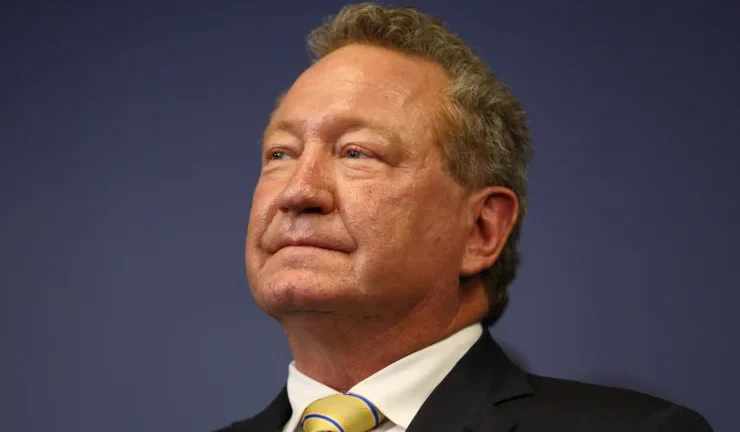
Andrew “Twiggy’ Forrest, a mining magnate from Australia, and other developers in Australia of large-scale projects to produce renewable hydrogen has supported the $2 billion scheme launched by the Albanese Government to jumpstart this fledgling industry. They also boosted their ambitions to convert water into fuel.
, the “hydrogen-headstart” program, was announced in the federal budget on Tuesday. Provides credits per kilogram for green hydrogen production to help bridge the gap between current market prices and production costs.
Hydrogen is a clean-burning fuel that emits water and could replace coal in manufacturing, natural gas for heating and electricity generation, and heavy oil in transport.
Most hydrogen produced today is “grey hydrogen,” made by a gas-to-gas process that releases carbon dioxide into the air. Green hydrogen is created when water is split into hydrogen and oxygen using an electrolyzer powered by renewable energy.
Producing it is prohibitively expensive compared to the hydrogen produced from fossil fuels.
Is the hype about hydrogen fuel a holy grail?
Forrest, who leads a multi-billion dollar push for iron ore giant Fortescue Metals Group to diversify into green hydrogen, called the new government scheme a “wonderful step” and acknowledged Australia’s necessity to remain competitive with the United States, where President Joe Biden’s Inflation Reduction Act aims to stimulate hydrogen production aggressively.
He said: “We now have a newly elected government, and its first budget has taken a significant step in supporting the industry so that we do not fall behind Europe or North America.”
Forrest said that while the scheme’s final design is still in development, it’s essential to match the US government’s tax credit of $4.40 per kilogram at $US3.
Chris Bowen, Minister for Climate Change and Energy, said that the Australian Renewable Energy Agency would conduct a competition to determine the amount of support to be provided to any project. He said that matching the tax credits offered in the US is not crucial because Australia has other advantages regarding hydrogen production. Bowen stated that “we do need to stay in the race.”
Eva Hanly is the regional director of Fortescue Future Industries’ green energy subsidiary. She said that customers worldwide are evaluating where they will source their hydrogen, and it is essential to make sure Australian supply projects can compete on price.
Hanly stated, “We are hearing from customers in Asia that they have a robust demand for green hydrogen, very quickly and at large volumes.”
If we don’t take that export market, another country will, and we will lose out on billions in future dollars.”
Workers bet $2 billion on the hydrogen industry.
The British energy giant BP is advancing three large projects for hydrogen in Western Australia. It said that the funding would signal Australia’s intent to become a global leader in renewable hydrogen and help the nation be globally competitive in producing versatile, zero-emissions fuel.
Lucy Nation, BP’s vice president for hydrogen in Australia and Asia-Pacific, said: “The Albanese Government has provided a much-needed response. It gives the industry more confidence to invest.”
This program of competitive production contracting assists producers in de-risking significant investments and attracts global capital to Australia.
The Albanese government will not include the so-called “blue” hydrogen, produced using coal or gas and carbon capture technology to eliminate emissions. The coal miners said that the budget should have taken advantage of an opportunity to concentrate on all forms of hydrogen production, including those using biomass, gas, and coal.
Low Emissions Technology Australia, an industry group representing black coal miners in Australia, has said the approach of the Australian government is contrary to the US Inflation Reduction Act, which provides technology-neutral credits for all low-carbon energy sources.
Mark McCallum, LETA’s chief executive officer, said that hydrogen with carbon storage and capture is a highly competitive source of clean hydrogen. LETA’s chief executive, Mark McCallum, said clean energy projects plan to leave or curtail regional investments.