NASA released another breathtaking image to commemorate the first anniversary of the release of the first full-color image taken by the James Webb Space Telescope.
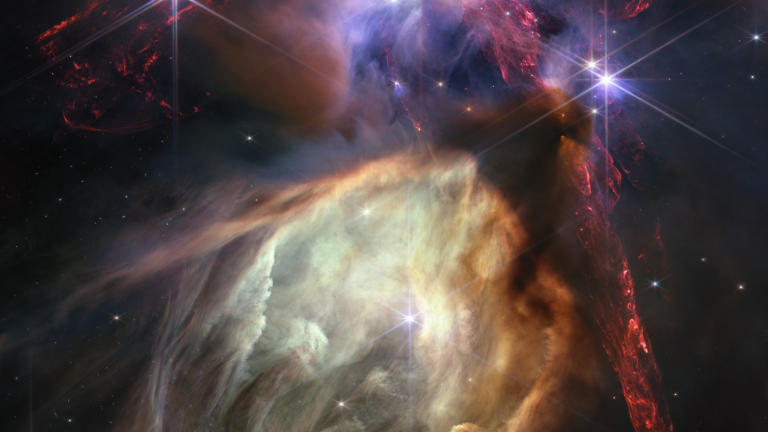
The US space agency has released a picture of the Rho Ophiuchi complex, located 390 light years away from Earth.
What does this image represent?
Stars and space dust
A NASA announcement explains that the Rho Ophiuchi Cloud Complex is the closest star-forming region on Earth.
NASA reports, “you’d never guess it by Webb’s chaotic close-up.”
The red areas in the picture are jets of molecular hydrogen.
NASA says that “these occur when a stellar nebula first bursts out of its natal dust envelope, shooting out two opposing jets in space like a new born first stretching out her arms into the world.”
The image shows about 50 stars, with most of them having a mass similar to the Sun.
The brightest white circle within the swirling green-yellow dust cloud is S1, a star NASA claims is “significantly larger than the Sun.”
Some stars show shadows that suggest the presence of a proto-planetary disk. This sounds solid, but it is a massive ring of gas and dust left over from the formation of the star.
A NASA fact sheet explains.
These clumps grow larger and form planets and satellites. Eventually, a solar system will develop around the star.
This is how our solar system was created.
This image is similar to an ultrasound, except the baby is a planet system.
NASA’s Klaus Pontoppidan explains that “Webb’s image of Rho-Ophiuchi allows for a new level of clarity in observing a very short period during the stellar life cycle.”
We can now see the beginnings of the story of another star.
Is this a picture?
The colors in the above image are not exactly as they appear to the human eye.
The image shown above was created by beaming back to Earth a series of separate exposures that were originally greyscale.
These images were captured using JWST’s Near-infrared Camera, which has a range of infrared wavelengths from 0.6 to 5 microns.
A NASA fact sheet states that the equipment enables astronomers to take photos of very faint objects surrounding a bright central object.
The dimmer objects can be captured by blocking the brighter objects’ light.
NASA explains that shielding your eyes from the Sun with a raised hand lets you concentrate on what’s in front of you.
Each image was captured using a filter that captures different wavelengths. Each filter was assigned a unique color.
The color is created by layering these images one on the other.
The colors that were used to create this image are:
How large is the complex?
NASA claims it is 0.7 light-years across.
One light-year is equal to about 9.4 trillion kilometers.
This image has a diameter of approximately 6.58 trillion kilometers, which is why there are so many Sun-like star clusters in one picture.
Can I zoom in?
The image is compressed so that our website can load it quickly.
You can view a zoomable picture on the NASA website for more detail.
Why is JWST a big deal to you?
This is the most powerful space telescope ever built.
This telescope replaced the Hubble Space Telescope.
Hubble’s images were incredible then, but now that JWST has a much larger telescope and can observe infrared, we’ll have an even better view of the universe beyond.
JWST has been developing since 1989 and will be launched into orbit on December 25, 2020.
NASA Administrator Bill Nelson said that the James Webb Space Telescope has changed humanity’s perception of the cosmos in just one year. “We can now peer into dust clouds, and see light from distant corners of the universe,” he says.
“Every new image represents a discovery. It allows scientists to ask questions and find answers they never could have imagined.
“Webb represents an investment in American Innovation, but it is also a scientific feat made possible by NASA’s international partner who shares a can-do spirit and a desire to push the limits of what we know to be possible.
The mission was undertaken by thousands of scientists, engineers, and leaders who have dedicated their lives to the cause. Their efforts will continue improving our understanding of origins and our place within the universe.