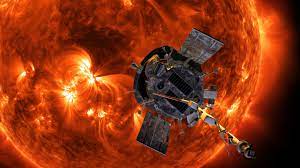
NASA’s Parker Solar Probe has flown near enough to the Sun to detect fine details of the Solar Wind near where they are generated on the surface of the Sun. These details are lost when the wind leaves the corona in a uniform blast.
The water blast is like a showerhead spraying water in your face.
A team of scientists led by Stuart D. Bale of the University of California at Berkeley and James Drake of the University of Maryland College Park report in a paper that will be published this coming week in Nature that PSP has detected high-energy particle streams that match supergranulation flow within the coronal hole, suggesting that these regions are where the “fast” solar winds originate.
Coronal holes occur when magnetic field lines are formed from the surface of the Sun without looping inward. These open field lines then expand outward to fill the entire space surrounding the Sun. During quiet sun periods, these holes are located at the poles so that the solar wind they generate doesn’t reach Earth. When the Sun’s magnetic field flips every 11 years, the holes are visible all over its surface. They generate solar winds that hit Earth.
Understanding where and how the solar wind originates can help predict solar storms, which, while creating beautiful auroras, can also cause havoc on satellites and electrical grids.
Drake explained that understanding the mechanism of the solar wind was important to Earth for practical purposes. Drake said this would affect our ability “to understand how the sun releases its energy and drives geomagnetic thunderstorms, which pose a danger to our communication networks.”
According to the team’s analyses, coronal holes look like showerheads with roughly evenly spaced jets, emerging from bright spots where magnetic field lines funnel in and out of the solar surface. Scientists claim that oppositely-directed magnetic fields can pass each other in these funnels up to 18,000 miles wide. The areas break and reconnect, sending charged particles from the Sun.
Bale explained that the photosphere was covered with convection cells. “Like a pot of boiling water, this larger scale convection is called supergranulation.” “Where these super granulation cells meet and move downward, they drag magnetic field along their path to this funnel-like downward flow,” Bale said. There, the magnetic field is very intense because it is jammed. It’s like a magnetic field scoop going into a drain. “We’re now seeing the spatial separation between those little funnels and drains in solar probe data.”
The researchers concluded that magnetic reconnection, a process referred to as the creation of the solar wind, was the only way it could be done. PSP was established in 2018 to solve two contradictory explanations of the origins of high-energy particles that comprise the solar wind. These were magnetic reconnection and acceleration by Alfven or plasma waves.
Bale stated that the magnetic reconnection in these funnel structures is the energy source for the fast solar winds. It’s not just everywhere in the coronal hole. It’s substructured inside coronal holes to this supergranulation cell. These little bundles are magnetic energy associated with convection flow. “Our results are, we believe, strong evidence that reconnection is doing this.”
Nour Raouafi of the Applied Physics Laboratory, Johns Hopkins University, a Parker Solar Probe scientist and co-author, reported that the funnel structures would likely correspond with the bright jet that lets Earth sees inside coronal holes. APL built, managed, and operated the spacecraft.
Sun-splashing
The solar wind is a turbulent, homogeneous flow that combines charged particles with roiling magnetic forces. This interaction with Earth’s magnetic field releases electrical energy in the upper atmosphere. The solar wind is a turbulent flow of charged particles and magnetic fields that interact with Earth’s magnetic field to release electrical energy into the upper atmosphere. NASA’s Living With a Star Program, which funded PSP, has a mission to predict the strongest winds, known as solar storms, with their effects on Earth.
The probe’s purpose was to find out how charged particles, such as protons, heavier ions, and electrons, are accelerated by the Sun to escape its gravity.
PSP needed closer than 25-30 solar radii to achieve this. This is equivalent to about 13,000,000 miles.
Bale explained that the solar wind is less dynamic and more structured once you reach a lower altitude (25 or 30 solar radii). You can see the imprints left by the Sun.
PSP’s instruments in 2021 recorded magnetic field switchbacks within the Alfven wave that appeared to be related to the regions where the solar wind is produced. The data showed that by the time the probe had reached 12 solar radii — 5.2 million miles — from the surface, it was clear the search was not just passing through turbulence but jets of material. Bale, Drake, and their collaborators traced the jets to supergranulation cells, which are magnetic fields that gather and funnel toward the Sun.
Was the acceleration of charged particles in these funnels due to magnetic reconnection, which would have to slingshot the particles outward, or waves of hot plasma — ionized particle and magnetic field — streaming out of the Sun as if surfing a wave of hot plasma?
Bale said that the fact that PSP detected particles with extremely high energies in these jets – tens or hundreds of kiloelectron voltages (keV), as opposed to a few for most solar winds particles – told him that magnetic reconnection must be what accelerates particles and creates Alfven waves that give particles an additional boost.
Bale explained, “Our interpretation is these jets of outflow from reconnection excite Alfven wave as they propagate.” This is a well-known observation from Earth’s Magnetotail, where similar processes occur. I can’t figure out how wave damping could produce hot particles of up to hundreds of keV when produced naturally by the reconnection. We see it, too, in our simulations. “
The PSP will be limited to about 8,8 solar radii — or approximately 4,000,000 miles — from the surface without damaging its instruments. Bale hopes to confirm the team’s conclusions with data collected at that altitude. However, the Sun has entered solar maximum, and the activity is more chaotic, which may make it difficult to see the processes scientists are trying to view.
Bale stated, “There was some confusion at the start of the mission about whether we were going to launch the probe right into the quietest and most dull part of the solar cycle.” “But, without it, we wouldn’t have understood this. It would have just been too messy. “I think it’s lucky we launched in the solar minimus.”