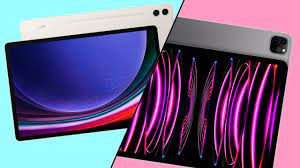
Samsung has unveiled the refreshed Galaxy Tab S9 tablet. The three-pronged strategy with Tab S9+, S9 Ultra, and Tab S9 models is designed to compete with the Apple iPad lineup. How does the Tab S9+ compare with other devices? This comparison will reveal the similarities and differences between the Tab S9+ and the 12.9-inch iPad Pro released in 2022. Find out if the Galaxy Tab S9+ is the better option for you.
Prices, availability, and specifications
The Galaxy Tab S9+ has been announced at Samsung Galaxy Unpacked on July 26. The Tab S9+ and its Tab S9 or Tab S9 Ultra sibling are now available for preorder. A full release date of August 11, 2023 is expected. If you’re buying before the official launch, check Samsung Tab S9 Series preorder deals.
Samsung differentiates the Galaxy Tab S9+ from the rest refreshed tablets primarily due to their different pricing. Standard Galaxy Tab S9+ comes with Wi-Fi 6E and Bluetooth 5.3. It also has 256GB of storage. The price starts at $1,000. Tab S9+, 5G with similar specs, is priced at $1,150. You can learn more about the differences by reading my guide that compares the Galaxy Tab S9+ and the S9+ 5G.
Apple’s iPad Pro was recently updated in 2022 when the M2 processor was introduced. For this comparison, the iPad Pro is available in both 11-inch and 12.9-inch sizes. The 12.9-inch iPad Pro, Gen 6, released in 2022, is available from various retailers, including Amazon, Best Buy, B&H, and Apple.
The price of models with 128GB storage is $1,099, increasing by $100 each time you add 128GB to make 1TB. The 2TB model is $2,199. The iPad Pro’s 5G connectivity adds another $200 to the storage cost.
You can also Design Your Own
Samsung’s Galaxy Tab S9+ has a 12.4-inch AMOLED screen. This translates into an overall package measuring 11.23 x 7.33 x 0.22 in (285.4mm by 185.4mm by 5.7mm). The Tab S9+ with 5G capability weighs only 1.28 pounds (581g), whereas the 5G models are 1.29 pounds (586g). It’s not a big difference, and you won’t feel it daily.
Tab S9+ is available in Beige or Graphite. Even the S Pen is IP68 certified for water and dust resistance, so your tablet will continue to run in any conditions. The S Pen is held in place by a magnet on the Tab S9+’s back when it’s not being used. It will also charge while attached. The Tab S9+ has four AKG speakers built into the body. Dolby Atmos is also included to provide extra surround sound effects.
Apple’s 12.9-inch iPad Pro is the top of its line. It has a 12.9″ display and a body made from aluminum measuring 11.04 x 846 x 0.25 (280.6mm by 214.9mm by 6.4mm). The Wi-Fi models weigh just 1.5 pounds (682g), while the Wi-Fi + 5G models weigh 1.51 pounds (685g). Silver and Space Gray offer a little variety, but like the Tab S9+, the entire flash is in the display. The iPad Pro has a USB4/Thunderbolt connector, while the Tab S9+ uses USB-C 3.2 Gen 2.
The iPad Pro has four speakers and five microphones built into its chassis. This allows for loud, full sound regardless of how the tablet is used. The Apple Pencil can be held in place by a magnet on the iPad Pro’s edge. The iPad Pro does not have an IPX rating, measuring its water and dust resistance. This makes it less durable than the Tab S9+.
Display
Both tablets boast impressive displays, among the best in the industry. Samsung does not list the resolution of its AMOLED screen, but it appears to be around 2800 x 1552. The Tab S9+ has a 12.4-inch AMOLED 2X display. The screen can be set to respond in 0.3ms for gaming. Samsung’s AMOLED technology allows for brightness and color adjustments to be made at the LED level. This results in a picture with very light whites and dark blacks.
Thin bezels surround the screen, and the front-facing cameras are not required to have a notch. The Tab S9+ comes with a Samsung S Pen, compatible with inking. A fingerprint reader is embedded beneath the screen for extra security.
The iPad Pro features a slightly larger 12.9.-inch liquid-retina XDR display, with mini-LEDs and 2,596 local dimming zones for excellent brightness, color, and contrast. The iPad Pro has a resolution of 2732 x 2204, which is 264 pixels per square inch. Its brightness can reach 1,600 nits when HDR content is used. It has excellent color reproduction in sRGB, DCI-P3, and other color gamuts.
Cameras
The iPad Pro rear camera array includes a 12MP wide angle lens with an f/1.8 opening and a 10MP Ultra Wide lens with an f/2.4 opening and 125deg field of view. These cameras have various features, including Smart HDR 4, 2x optical and digital zooms, 5x digital zoom maximum, and 4K video. The iPad Pro has a 12MP TrueDepth Ultra Wide camera on the front with a 122deg field of view and an f/2.4 opening. The iPad Pro is set up for great selfies with portrait lighting, bokeh, FHD video, Smart HDR 4, and more. LiDAR on the iPad Pro also works with apps that scan 3D objects, giving you an additional tool for some workflows.
Samsung has provided some basic specifications. The tablet’s rear has an autofocus 13MP camera and an 8MP ultrawide one, while its front has a 12-megapixel ultra-wide camera. The ultra-wide cam will lose some pixels, but the rear camera’s 13MP is better than the iPad’s 12. Apple’s effects may differ for those who love to take selfies or add after-effects.