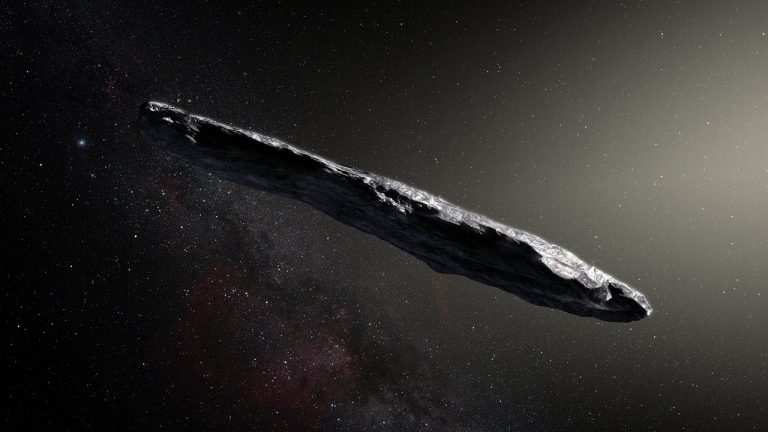
Oumuamua’s journey through our Solar System in 2017 was noticed by people worldwide. This was the first Interstellar object that astronomers ever discovered. In August 2019, Comet 2I Borisov made its way through our Solar System. It was the second ISO that visited. The combined visit of the ISOs sparked a wave of inquiry and speculation.
There are likely more than two interstellar objects. A new study suggests our Solar System may have captured some of them, but they only stay short.
Even though ISOs are rare in the Solar System, many have likely visited. Astronomers believe that some of these objects could be captured on Solar orbits. This study examines ISO capture and tests the theory that some ISOs can be caught on near-Earth orbits instead of Solar orbits. Researchers behind the study say there could be a constant population of ISOs near-Earth rotation.
Finding small objects in space can be extremely difficult. We only get weak images or stars of another solar system. Astronomers can detect debris disks, but they cannot see fine details. It’s great that some solar systems have sent us an uninvited emissary. These ISOs can provide insight into how other solar systems form and evolve.
Authors of the paper state that ISOs are a great way to “… study the formation and evolution planetary systems. They also mention whether ISOs exist in our Solar System is of major interest to astronomers. They write that “ISOs are rare, but can be captured by other planets within the solar system into orbits bound to them.”
The paper’s title is ” Near Earth Orbit Interstellar Objects: Exploring their Presence.“. The paper’s first author is Diptajyoti, a graduate of Computational Astrophysicist at Carnegie Mellon University. Hy Trac is one of the authors, along with Amir Siraj and Avi Loeb. The paper has yet to be peer-reviewed.
Recent research has shown that the Oort Cloud could contain more ISOs than native Solar System objects. Some research indicates that cosmic rays could destroy most ISOs. Some papers show that ISOs will be pulled toward Jupiter and then destroyed.
They did not examine ISOs captured in near-Earth satellite orbits.
The study is based on numerical simulations. Each particle represents an ISO that could be on a different trajectory outside the Solar System. The simulations are mainly based on scattering effects where various combinations of Earth, Moon, Sun, and Jupiter affect an incoming particle differently.
This research involves the cross-sections in space and velocity, which result in ISOs captured in near-Earth orbits. Researchers call these capture cross-sections and have placed them after running a series of N-body scattering simulations to identify trends.
The results indicate that Jupiter is the dominant player. Earth-Moon capture cross-section “… and Jupiter capture-cross-section dominate the captures of interstellar bodies into near-Earth-orbits by a factor 10 4 compared to the Earth-Moon. The authors found that if an ISO were captured, it would be greater than 10 AU. The Centaurs are located here. Centaurs are tiny Solar System bodies with unstable orbits due to interactions with giant planets. Could ISOs be hidden among the centaurs?
Captured ISOs will not have stable orbits. Data from the team shows that ISOs can be charged and placed in near-Earth orbits. However, looking for them on their initial orbits may prove futile. It would be too simple. Nature rarely reveals its secrets in such a straightforward way.
“We warn the reader that it does not accurately represent ISOs captured by Earth or Jupiter today (should such ISOs exist). “ISOs captured in previous times will have their orbital parameters change over time due to interactions with other planets within the Solar System,” the authors explain.
To test the survival of ISOs, the team calculated long-term orbits for a subset of captured ISOs. The team plotted the survival rate of objects on their near-Earth orbits. These ISOs may escape from their original capture orbit and enter another captured orbit. However, they are not included in this effort.
After a captured ISO has left its orbit near Earth, it goes to the Solar System. It can also take up a different trajectory with a bigger perihelion. Earth captures objects with a survival rate that is two to three times higher than Jupiter.
They won’t survive long if they are in near-Earth orbit. The half-life for ISOs captured into near-Earth orbits by Jupiter is about 50,000. Earth-Moon captured ISOs have a life of 130,000 years. A different way to look at it is that Jupiter-captured ISOs will only be 10% of their original population in 800,000 years. It’s 2.1 million years for ISOs captured by Earth-Moon.