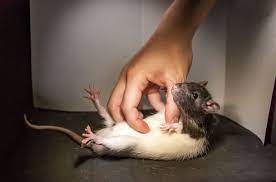
Scientists must be able to simulate environments conducive to play to study animal play behavior. Rats are less likely to play when they are restrained or anxious. There is also little data about the brain activity of free-playing rats. Researchers in Neuron reported on July 27, after getting rats to feel comfortable with a human partner, tickling them in controlled conditions, and measuring their brain activity and squeaks, that the periaqueductal grey is essential for play and laughter.
Michael Brecht, the senior author, and neuroscientist from the Humboldt-Universitat zu Berlin, says: “We know vocalizations like laughter are important in play. This supported the idea that some kind of organization signal within the brain regulates this behavior.” Children, for example, check to see if their play-fighting partner is laughing. When their playmate stops laughing, they stop fighting.
Scientists do not yet know what neural pathways control play in humans and other animals. Researchers wanted to learn more about play’s neuroscience and ensured the rats could move freely throughout the experiment. They also gave the rats some time to adjust to their new surroundings. After the rats had become comfortable, researchers tickled them on their bellies and backs. They also played “chase-the-hand” games with them. When amused, rats squeak in a high-pitched sound not audible to humans. Researchers monitored the sound to make sure that the rats were enjoying themselves.
Researchers found that the PAG, also known as the lateral column, showed strong responses to tickling and play in these animals. When this part of their brain is inhibited, rats stop playing and laugh less. If the rats were placed in an unfamiliar, anxiety-provoking environment, they stopped laughing, and the activity of tickling and play-responsive PAG cells decreased.
PAG, located in the middle brain, has previously been used for controlling vocalizations and fight-or-flight responses. The PAG may also be involved in play-fighting, as it can trigger a fight or flight response. Research has shown that playfulness can persist even when the cortex (which controls consciousness) fails to develop. This suggests that play is an instinctual behavior.
Brecht says that many people undervalue play, which they consider to be childish and not very decisive. But play is essential. Play is a behavior that can be self-taught. Brains are usually used to control behavior. “Play behaviors seem to be a way of growing brains.”
The researchers will then observe if other animals show similar behavior when being played with. This could help them compare the playfulness between different species. The researchers also want to test if different play styles for younger rats could affect the development of the lateral column.