Every solid body in our Solar System is affected by impact cratering. It is the most dominant process that involves the surfaces of extraterrestrial objects today. However, on Earth, these craters can be lost by geological processes over time. But elsewhere in the Solar System, many examples of impact craters are preserved.
Moon Basin South Pole-Aitken basin
It’s a giant crater: the oldest, largest, and most profound impact crater ever found on the Moon. It has a diameter of 2,500km, is between 6.2 and 8.2km in depth, and was formed around 4.2 billion years ago. As its name implies, it is located at the south pole of the Moon’s far side. However, the crater can be seen on Earth as a dark range of mountains on the border of the dark and light sides.
Lunar scientists love to visit this site and learn more about the geology of our Moon. The crater excavated is nearly as deep as Earth’s deepest ocean trenches. This crater gives us an incredible view of the interior of the Moon’s crust. It exposes 4.2 billion years’ worth of history.
The first scientific experiments were conducted in 2019 by a Chang’e 4 rover operated by the Chinese space agency. One of the most fascinating was the Moon Micro Ecosystem. This collection of seeds, insect eggs, and other materials was designed to test if life can flourish in such a small biosphere.
Unnamed Crater (S1094b), Mars
Many craters are famous on Mars. From the home of Mars rovers ( Gale Crater of Curiosity and Jezero of Perseverance) to the hypothesized source regions of Mars Meteorites ( Toting and Mojave). One of the most recent craters discovered on Mars is very dramatic.
Mars rovers may get all the credit for discovering the Martian surface, but satellites orbiting Mars have made their discoveries for decades. NASA’s Mars Reconnaissance Orbiter was launched in 2005 but is still operational. Its 16+ years of images from Mars’s surface allow us to compare data sets year-on-year.
InSight, NASA’s InSight spacecraft, detected on Christmas Eve 2021 a “Marsquake,” a significant impact on Mars. MRO data helped identify this as a new impact on the opposite side of Mars.
The bright, vibrant impact ejecta (blankets of material thrown away by the impact) are visible from space, thanks to the context camera data aboard InSight. We even know what it sounded like.
Enki Catena, Ganymede
Enki Catena, a chain crater located on Ganymede (one of Jupiter’s Galilean satellites), is one of the most beautiful craters in the solar system. Jupiter is a mini-planetary system with more than 90 moons.
Jupiter’s gravitational force creates tidal effects that shape the moons, giving us some of the most interesting geological features yet discovered, from the volcanoes on Io to Europa’s subsurface ocean. There are also a series of craters on two of the Moons, Callisto & Ganymede.
The first time these crater chains were spotted was when the Voyager 1 probe took some of the very first images of the surfaces of these moons back in 1979. These crater chains were initially considered collapsed lava tubes seen on Mars and the Moon.
The origin of these chains was a mystery until the Shoemaker-Levy 9 comet smashed into Jupiter. This comet was observed breaking up into multiple pieces, which gave an idea of how these chains could form. Jupiter’s gravity pulls objects apart into many parts, impacting them closely together.
Enki Catena consists of a series of 13 craters that crosses from a dark terrain to a bright one on Ganymede. It measures 162km long and is about 10km wide.
In the 2030s, the European Space Agency Juice mission is scheduled to visit the Jovian System, allowing us to view the surface in greater detail. There may be more crater chains.
Occator Crater, Ceres
Ceres is the most significant body in the central belt of asteroid bodies between Mars and Jupiter. It’s large enough and round to be called a “dwarf world” along with Pluto, Eris, Makemake, and Haumea.
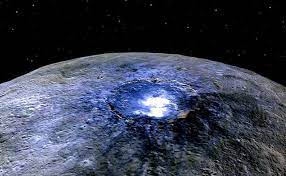
The Occator Crater on Ceres has a bright center seen from space and at the Mauna Kea Observatory in Hawaii.
NASA’s Dawn spacecraft entered orbit around Ceres and photographed the bright spot called “Spot 5” in Occator Crater 2015. The crater’s floor is covered with a glowing dome of salts that measures three kilometers in diameter. This is likely the result of hydrothermal activity.
The crater is 92km across and 3km high. Simulations suggest that the space rock (which created the crater on Ceres) was about 5km in diameter and struck the planet between 20-25 million years ago.
Aurelia and Venus
Venus is also known as Earth’s twin. Venus is similar to Earth in size, but surface images show that the two planets are very different.
NASA’s Magellan satellite captured the best images of Venus in 1990. Venus is covered in a cloudy atmosphere, and visible light cameras cannot see the surface. Magellan had a radar that could “see” the surface, but the images were difficult to interpret.
Dark terrain appears smooth in radar images, while bright landscape seems rough. Radar images show impact craters very well. They appear luminous because the ejecta is coarse and contrasts with the volcanic plains.
Aurelia is a 32 km-long impact crater located on Venus.
It stands out from the grey landscapes surrounding it. The smooth black surfaces on the edges of bright white ejecta were formed by rock flows that melted as the impact struck.
Recently, a University of Alaska Fairbanks team used Magellan data to locate the first active volcanic site on Venus.
NASA is developing 3 Venus missions in the next 10 Years. Hopefully, we will soon know more about our mysterious twin.