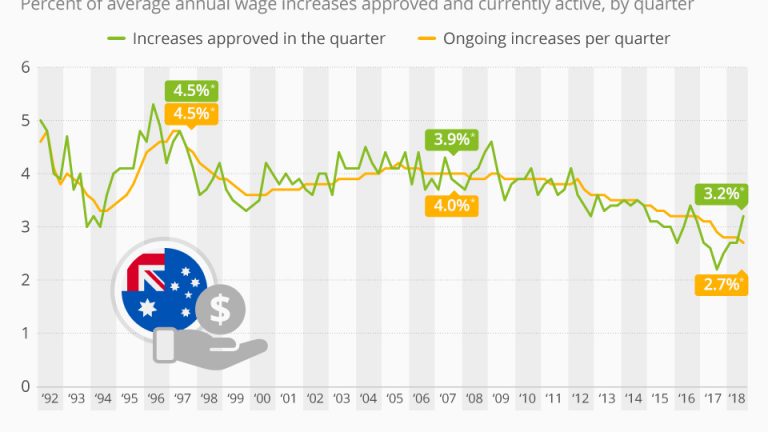
Wages for Australian workers have reached their highest level in over ten years, as the country has low unemployment and tight labor markets.
The Australian Bureau of Statistics (ABS) latest data revealed that the wage price index increased by 0.8 percent in the quarter ending March 2023.
The annual pay growth rate has risen to 3.7%.
Leigh Merrington, ABS’s acting head of price statistics, said that the annual growth was a good indicator of Australia’s job market.
“Annual wage growth of 3.7 percent is the highest since September 2012 quarter, reflecting low unemployment and a tight labor market, as well as high inflation,” said Merrington.
Merrington said that the private sector is Australia’s primary driver of wage growth.
“Merrington stated that several industries in the private sector have experienced annual wage growth exceeding 4 percent, while all other industries have seen annual wage growth exceeding 3 percent.”
The public sector, however, recorded the most enormous quarterly growth of the past decade at 0.9 percent and 3 percent annually.
The sector is now undergoing enterprise agreement negotiations, planned increases, and a higher wage cap.
The data also shows that several jobs receive wage increases despite a tight economy.
Merrington stated, “Wage results over the March quarter of 2023 showed a continued rise in the share (of jobs) receiving wage increases of between 4 to 6 per cent. This is the highest percentage since 2009”.
The share of jobs with a wage increase of less than 2 percent has dropped from more than 50 percent in mid-2021 to less than 20 percent today.
Although wages have increased by 3.7 percent in the past year, they are still well behind inflation which is currently at 7 percent.
Reserve Bank of Australia foreshadowed that interest rates could increase again in June.
The central bank forecasts that wages will rise by 3.5-4% per year without inflating the price level.
If wages continue to increase at the current rate, this would only add to the concerns of the bank board that inflation could be affected and thus strengthen the case for future rate increases.
Treasurer Jim Chalmers believes that wages are not the leading cause of inflation.
He said that decent wage increases are not the problem but part of the solution to cost of living pressures on families.
“We are facing an inflation problem for many other reasons and not because people were paid too much.”
The announcement comes at a time when worker unions have called for an increase in wages of 7% in line with inflation, and Fair Work hearings are currently being held into the issue.