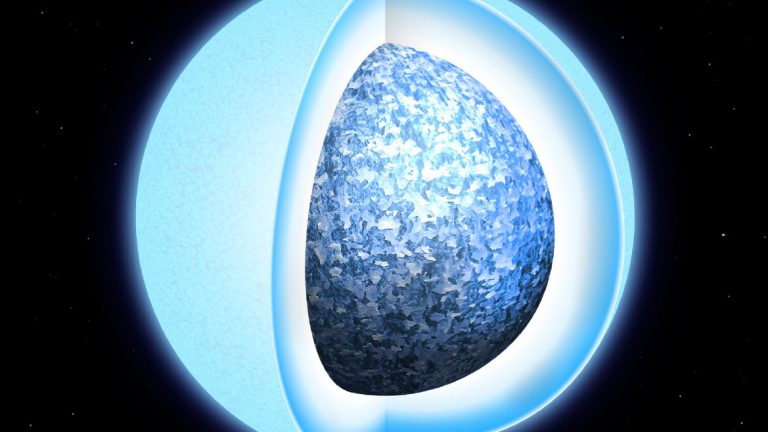
The white dwarfs are stellar remnants from stars such as our Sun. Astrophysicists believe that their cores could crystallize to form enormous diamonds. They need to find and age more of these objects to better understand the process.
Fusion stops when stars of similar mass as our Sun run dry of hydrogen. They leave the main sequence and turn into red giants. Chaos occurs when the star’s self-gravity is weakened by its mass loss. The star can’t hold on to itself, and its outer layers fall into space. This creates the beautiful planetary-shaped nebulae we have all seen through telescope images. These nebulae are only around for a few thousand years.
It’s not over yet. The white dwarf is the remnant of the star, which is as massive and significant as the Sun. White dwarfs consist of dense globules of mostly electron-degenerate material that can last quadrillions of years. White dwarfs, even though they have abandoned their fusion life, still emit enough thermal energy to power the beautiful nebulae that they leave behind.
According to theory, a white dwarf could last 100 quintillions of years. It takes a very long time for them to cool down, and they can form giant crystals during that process. Astrophysicists have a signature for crystallization that they can observe, but the timing is off.
The core of a white dwarf is initially liquid. As the star cools and ages, the liquid becomes a solid. The star’s heat increases when this happens. This heat was a signature and predicted the distinct sequences that white dwarfs went through on Hertzsprung-Russell Diagram. This is a good theory, but it’s not backed up by precise measurements of temperature or age for white dwarfs. The HR Diagram plots a star’s brightness versus temperature. The ESA Gaia spacecraft published its second dataset in 2018, adding more detail to white dwarfs on the HR Diagram. Gaia can measure white dwarf parallax with precision, which was previously difficult. The new data revealed three different evolution tracks for white dwarfs. Two of the tracks were parallel and well-understood. The third white dwarf was wholly unique and did not follow the evolutionary paths of known white dwarfs.
Tracks A and B show white dwarfs cooling continuously, which is a characteristic that makes them stand out from other stars. Q, however, shows how white dwarfs release heat when they crystallize. This raises their temperature and delays their cooling.
Gaia data, however, is not based on a single observable star. This is more like mass data. Gaia released its second data based on more than one billion light sources. A research team extracted from the dataset 260,000 white dwarfs that were likely to exist. This increased an order of magnitude in the available number of white dwarfs. It also allowed the team to describe the crystallization processes.
There still needs to be data available on the exact timing of crystallization. A separate group of scientists is now seeking clarity and have found the perfect tool: a white dwarf amid crystallizing. The white dwarf in this system is a main-sequence star, which is why it’s so essential to the work. The white dwarf is in a system with other main-sequence stars, which makes it easier to determine their ages.
The authors report in their paper that the white dwarf HD 190412 C is bound to the triple star HD190412 and forms a new Sirius-like system in the solar neighborhood. The location of HD190412 C in the T eff mass diagram indicates that it is crystallizing. This makes this the first confirmed white dwarf crystallizing whose age can be externally determined.
It is located about 104 light years away and consists mainly of metallic oxygen. The white dwarf is similar to Sirius B, another nearby white dwarf. Researchers are focusing on the cooling of the star and the delay that crystallization causes.
The team writes: “Motivated to see if a cooling delay due to crystallization could be directly detected, we use various methods to constrain the age of this system.”
It’s more challenging than it may seem to determine the age of main-sequence stars accurately. Astronomers try several methods to constrain the ages of main sequence stars. Astronomers use isochronal fitting to compare a star’s temperature and brightness with model isochrones. (Isochrones consist of sets of physical parameters such as metallicity and mass.
Second, stellar kinematics. The motion of stars in their galaxy can provide some insight into the star’s age. Older stars move faster, whereas younger ones tend to move slower.
Astronomers can also determine the age of a star by analyzing its chemical composition. The magnetic field of a star can provide clues about its age. Over time, magnetic fields can weaken in sun-like stars.
“The association of HD 190412 C to the main sequence star HD 190412 A makes it the first identified white dwarf whose age total can be externally constraint,” write the authors. “… It is theoretically possible to detect a delay in cooling by comparing model age against the age of the system.”
According to their research, the universe’s age is 7.3 billion (+1.9/-1.8) years.
There are some caveats to this number. The researchers claim that while the ages of the four stars are compatible, their results indicate the white dwarf is underestimated.
Researchers wanted to test cooling models for white dwarfs and determine the crystallization time. The goal is to determine the age when the white dwarf begins to experience a cooling anomaly due to the crystallization of its core. Unfortunately, the age estimate they have is not precise enough to be able to pinpoint it completely. However, future attempts to determine the age of the white dwarf will hopefully be more accurate.
Although the age of its crystallization is not precise, it’s less uncertain. Researchers determined the star’s temperature and mass, “… which placed it firmly within the parameter space predicted for white dwarfs undergoing core-crystallization. This makes it the world’s first crystallizing white dwarves in a Sirius-like system. The star’s location within a Sirius system is crucial because it allows for investigating its age.