The term space junk is used to describe the large number of abandoned human-made items that orbit the Earth. This debris includes old satellites and rocket stages that have been used, as well as fragments from collisions or even tiny flecks of paint. The accumulation of debris has increased as space exploration and satellite deployments have grown. There are currently millions of pieces estimated of space debris, from large debris to small fragments too small to track. NASA estimates that 23,000 of these objects are more significant than a softball.
Space junk is a problem for many reasons. The sheer amount of debris in space increases the chances of collisions. The Kessler Syndrome is a cascade of events that these collisions can cause. The risk of collisions increases, and the destruction of satellites or spacecraft increases with each crash. This poses a severe danger to both manned as well as uncrewed missions. Space junk also reduces the number of orbital parking spaces for new satellites.
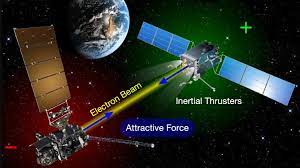
However, cleaning up the debris can be a difficult task. Even the smallest particles can be dangerous when they come into contact with them. Researchers from the University of Colorado Boulder took a page from a science-fiction novel to devise a solution for this challenging problem. The researchers have developed a type of tractor-beam that can pull or push an object without touching it. The tractor beam on the Starship Enterprise may be slower and more powerful, but you have to begin somewhere.
This innovation relies not on the sophisticated technology of science fiction gravitational beams but an ion stream that generates fast-moving argon ions. This ion stream can blast space junk, giving it a negative charge. The vehicle using the ion guns will also become more positively charged. The objects will move in the direction of each other due to the different costs. This is similar to the electrostatic effect you get when you rub a balloon on your head.
The conditions in space are very different from those on Earth. The team built a vacuum chamber called the Electrostatic Charging Laboratory for Interactions between Plasma and Spacecraft to test their theories. In ECLIPSE, they can simulate the thin layer of plasma and free electrons that surrounds our planet from orbital heights. Using this realistic environment, they were able to introduce debris and confirm their ion guns could attract it, with the expectation of seeing the same effect in space.
It would take a long time to accomplish this. According to the results of ECLIPS experiments and computer simulations, the tractor beam can pull a satellite that weighs a few tons 200 miles over two or three months. This may seem small, but it’s enough to free up valuable space for new satellites. This garbage collector can be used many times and eventually clean up vast swaths of the sky.
Simulations and testbeds do not reflect reality. The team has much work to complete before the tractor beam is deployed in real life. One reason is that debris can be challenging to grasp because it tumbles about in orbit. Researchers believe the tractor beam can stabilize objects before pulling them into orbit, solving this problem. However, it has yet to be tested. Many questions remain about deploying tractor beams and what to do when the junk is captured. With more effort, space around the Earth could become a much friendlier environment for satellites and spacecraft.