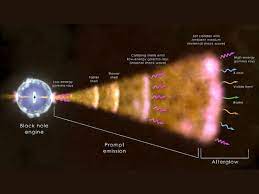
WASHINGTON (June 7, 2023) – When scientists detected the gamma-ray burst known as GRB 221009A on October 9, 2022, they dubbed it the BOAT, or the brightest of all time. Scientists studying GRB 22009A have described an unusual structure of the material jets expelled in the initial burst. This may explain GRB 22009A’s extreme nature and why the afterglow was visible so long after it occurred. Scientists at George Washington University and collaborating institutions published their findings in Science Advances today.
Gamma-ray explosions are among the most potent and energetic blasts in the Universe. They release the same amount of energy in a few moments as the Sun does in its lifetime. Scientists believe that the collapse of a massive black hole caused GRB 221009A.
The research team examined troves and troves of data gathered from October’s gamma-ray burst. They found that GRB’s jet had a narrow core with large sloping wingtips. This jet was unlike those seen in other cataclysmic gamma-ray bursts. It may also explain why scientists continued to see GRB’s multiwavelength glow months after the explosion.
Brendan O’Connor is a GW graduate student who led the study. He says, “GRB 22009A represents a huge step forward in understanding gamma-ray bursts and demonstrates that most extreme explosions don’t obey the standard physics assumptions for garden variety gamma-ray bursts.” O’Connor was the team leader using the Gemini South Telescope to observe the event in October. “GRB 221009A could be the equivalent Rosetta Stone of long GRBs. This would force us to rethink our standard theories about how relativistic outflows form in collapsing mass stars.”
Alexander van der Horst is an associate professor at GW and co-author of the study. However, the recent gamma-ray bursts, particularly this study, have shown that we require more complex computer simulations and models of gamma-ray burst jets.
The article” A structured jet explains extreme GRB221009A” was published in Science Advances. O’Connor, van der Horst, and other GW scientists contributed to the study. These include physics graduate students Michael Moss and Chryssa Kouteliotou. Associate Professor Sylvain Guiriec and Research Faculty George Younes. Researchers from the University of Rome contributed to the study.