MBARI researchers and their collaborators published a study in Nature Today that provides new insight into one of the first points in animal evolutionary history. This occurred more than 700,000,000 years ago.
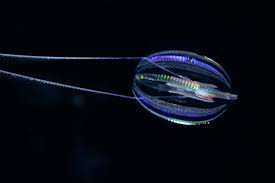
Scientists had spent more than a hundred years trying to determine the moment in time when a primitive organism gave birth to the vast array of animals that we see today. Scientists have examined two hypotheses to decide which animals, ctenophores or comb jellies (sponges), are the most distantly related. Scientists have long struggled to identify this anomaly, also known as the sibling group.
A team of researchers from MBARI and other institutions, including the University of Vienna and the University of California Berkeley, have mapped gene sets found on the same chromosome in all animals, from humans to hamsters to corals and crabs. This study provides evidence that comb jellyfish are siblings to all other species. Understanding the relationships between animals can help us better understand how specific features of animal anatomy have evolved, like the nervous system and digestive tract.
We developed a way to get one of the most profound glimpses into the origins of animal life. We used genetics to go back about one billion years to answer a fundamental question of animal evolution. Darrin Schultz was a graduate researcher at MBARI, UC Santa Cruz, and is now a Postdoctoral Researcher in the Simakov Group at the University of Vienna. This discovery will help the scientific community develop a deeper understanding of the evolution of animals and humans.
The sequences of chromosomes contain all the genes that make up an animal. Although the location of a gene sequence may change over time and between chromosomes, changes in the links between genes are rare.
Scientists have been relying on the similarity of the sequences of genes to answer questions that have existed for a long time about the oldest animal relationships.
Schultz’s team studied the links between genes that are conserved indefinitely. The team identified patterns in animals of different species and traced these linkages to the beginnings of animal evolution. The team discovered strong evidence that combs jelly represents a unique lineage whose ancestors split before the common ancestor for all animals.
The team compares the event to a fork in evolution’s road that occurred hundreds of millions of years ago. The ancestor of animals, a single-celled organism, traveled along this road with two offspring. One of the children, who would eventually evolve into the comb jellies we know today, chose one path. The genes on the chromosomes of this child stayed in a particular order as they developed and didn’t change much. The other child took the opposite path and would eventually evolve into sponges and all of today’s animals. The genes of its chromosomes were rearranged and fused. These rearrangements, irreversible in Nature and passed from generation to generation onwards, are still detectable today. The team discovered that sponges are not the siblings of comb jellies.
Schultz said, “The DNA of animals that are hundreds of millions of years old still contains the fingerprints of an ancient evolutionary event.” This research strengthens the basis of our understanding of animal genetics. It helps us understand what makes animals. This work will help us understand the essential functions we share, like how animals sense their environment, eat and move.”
Animals evolved independently along separate paths more than 700 million years ago.
Researchers have tried to understand animal relationships for over a hundred years. Most of that time, they believed sponges were the siblings of all other animals because they split from the Tree of Life millions of years ago.
Researchers were able, 15 years earlier, to prove, using new DNA-sequencing technology, that sponges were not the siblings of other animals. The scientific community was compelled to find new methods to confirm that ctenophores were the oldest animal branch. However, a definitive answer was not found.
Although groups of animals evolved hundreds of millions of years apart, an astonishingly large number of genes are linked to the same set of chromosomes in these vastly diverse groups. The sequence of genes may change over time, but the link between the chromosome and the gene remains constant, except in rare cases. Researchers have previously compared gene sequences for essential proteins to determine how organisms are related. They found, however, that this method did not provide reliable answers as to whether sponges and ctenophores are the sibling groups of all other creatures.
Schultz’s team first sequenced the entire genomes of two comb jellies, two marine sponges, as well as three close relatives that are single-celled animals, including a choanoflagellate (a type of algae), a filasterean bacterium, and an Ichthyosporean, to get a better understanding of their genes.
Researchers at MBARI used complete chromosome sequences to look for patterns of genes that were linked together. This helped them answer the question as to whether sponges and ctenophores were the closest relatives of all animals.
These changes, which are relatively slow in changing links between genes and the location of chromosomes, reveal how ancient genomes were arranged. Using distinct, rare differences and conserved patterns can unambiguously link all descendant lines. This can resolve long-standing animal-related questions.