Highlights
- MSK’s research has found an unexpected connection between chromosomal instabilities and epigenetic changes, both hallmarks of cancer, especially drug-resistant, advanced cancers.
- Together, these defects result in differences between cancer cells within tumors. This diversity helps the cancer cells to survive and resist treatment.
- This discovery opens up new research areas and therapeutic possibilities.
The curiosity of a graduate student has revealed a link previously unknown between two important cancer markers: chromosomal instabilities and epigenetic changes.
The study that resulted, published in Nature on June 7, not only opened a fertile area of basic biology research but also had implications for clinical care.
The number of chromosomes in each cancer cell can change. Epigenetic Alterations alter which genes are turned on or off within a cell without changing the DNA code.
Albert Agustinus completed a rotation at the lab of Samuel Bakhoum, MD, Ph.D. His research group at Memorial Sloan Kettering Cancer Center studies the impact of chromosome structure and number changes on cancer. Albert Agustinus is co-mentored with epigenetics specialist Yael David Ph.D. Her MSK’s Sloan Kettering Institute lab uses a chemical and biological approach to study epigenetic regulation.
Dr. Bakhoum explains that he came to me, saying, “I am interested in understanding the relationship between chromosomal stability and epigenetic modification.” “And I told him, “Well, there’s not an available connection, but you are welcome to find one! ‘”
He did find one, expanding his initial inquiry to a multi-institution, 32-author collaboration published in one of the top science journals. Bakhoum, David, and others jointly oversaw the study.
Agustinus recently recalled his first “aha” moment within the project. For this, he received a prestigious Drug Discovery Fellowship from PhRMA Foundation.
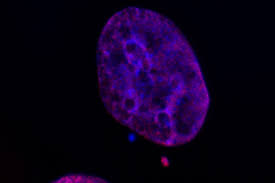
He was peering into the microscope with a lab colleague. He stared at cells with abnormal mini-nuclei, a typical result of chromosomal instabilities. They were also set up with fluorescent markings that would indicate the presence of epigenetic modification.
Agustinus: “The micronuclei were glowing much brighter than the primary nucleus.” My lab partner said, “I’ve never seen you smile so wide before.” ‘”
Chromosomes gone Wild
Chromosomes, which are DNA strands tightly packed together to carry genetic information, are the minor units of DNA. Usually, our cells have 46 chromosomes – half of which come from each parent. All 46 chromosomes should be in the new cells when a cell divides. However, in cancer, the process can go wrong.
Bakhoum says, “My lab is trying hard to understand how chromosomal instabilities drive cancer evolution, progression, and metastasis. Drug resistance is also a big issue.” It’s a characteristic of incredibly advanced cancers, where the normal cell division process goes haywire. You can have cells with 69 or 80 chromosomes instead of 46.
According to the prevailing view in the field, cancer cells can increase their chances of survival by rearranging their genetic material during division. This increases the chances that a cancer cell’s daughter will be able to resist the immune system attacks or medical interventions.
Bakhoum says, “This new study suggests this is only part of the picture.”
This is because two cancer cells can have duplicate extra copies of one chromosome but have different genes turned on or off. Epigenetic changes are responsible for this.
Further, our work suggests that epigenetic abnormalities can occur without mutations of the genes that code for epigenetic-modifying proteins. “All you need is chromosomal instabilities,” says Dr. Bakhoum. It’s a surprising but essential finding. It also explains why chromosomal instabilities and epigenetic anomalies are often found in drug-resistant, advanced cancers even when mutations of the type we would expect to create epigenetic havoc have not been detected.
The Micronuclei and Cancer
The micronuclei Agustinus observed through the microscope were rare. The natural repair mechanisms of the cell quickly eliminate them. If you see a lot of them, that’s a sign that something is wrong. Cancer, for example, can be a result.
These micronuclei, like the primary nucleus of a cell, contain genetic material in packages. The research team discovered that when these micronuclei explode, which they do frequently, it can cause even more problems.
Dr. Bakhoum compares himself to a traveler bringing a foreign accent back home. The research showed that sequestering chromosomes in micronuclei could disrupt the organization of the chromatin, a complex of genes that are packaged into chromosomes at cell division.
This causes epigenetic dysregulation that continues even after the micronucleus is reintegrated into a primary nucleus.
The accumulation of epigenetic modifications is caused by the formation of micronuclei and their reincorporation throughout many cell division cycles. They lead to increasing differences between cancer cells.
The more variations between cancer cells in a tumor, the greater the likelihood that some cells will resist any treatment. This allows them to continue to grow and survive.
Analyzing Epigenetic Changes
Researchers used a series of sophisticated experiments to isolate micronuclei to compare the changes that occur to those of the primary nuclei. They observed patterns of histone modifications — changes in the spools that DNA is wound around, which then alters access to genes.
Dr. David says, “This allowed us to ask important questions like: Do we get a transcription of genes important in specific pathways?” “Yes, we can get a transcription of genes important in specific pathways,” Dr. David says. ‘”
The researchers also compared intact micronuclei with ruptured ones, revealing more significant change in those that burst.