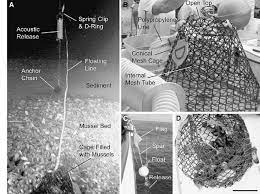
This bundle of non-living fibers, which mussels use as an anchor to their environment to resist crushing waves, for example, can be thrown away on demand. Mussels create this quick-release interface, a new study finds, by way of a neurochemically-mediated junction, where billions of motile cilia hold fast to interlinked biopolymer sheets. In a related Perspective, Guoqing Pan & Bin Li write that “[the study’s] results could be informative on how nonliving materials and living tissue can be dynamically interconnected.” This is especially true for detachable medical implants and biosensors. Advanced biomaterials need to be able to create strong and stable connections between living tissue and nonliving surfaces while still being able to remove them on demand. The large mechanical differences between soft biotic tissue and abiotic material have made it difficult to engineer such bio-interfaces. Jenaes Sivasundarampillai, with the help of his colleagues, studied the connection between the Mytilus foot and the stem roots of the byssus. Byssus, also known as “beard,” is a bundle made up of non-living fibers that mussels rely on to anchor themselves. The byssus stem root is attached to the foot tissue. Mytilus mussels can scrap the entire byssus despite the strong connection between the stem root and foot. This suggests that the bio interface of the byssus must be dynamically adjustable to allow quick release. Sivasundarampillai and colleagues sought to understand this ability better. The researchers used a variety of imaging and spectroscopic techniques to uncover a complex biointerface junction made up of biopolymer sheets that were interlocked with layers of living tissue, covered by nearly six billion soft motile cilia. The high contact surface between the cilia of the foot tissue and the lamellar stem root of the byssus provides a way of counteracting the mechanical mismatch. The oscillating movement of the cilia contributes to both the strength of the bio interface and its rapid release. Sivasundarampillai et al. Also, this cilial motion is controlled by neurotransmitters. This suggests that dopamine or serotonin controls the mechanical interaction between living and nonliving tissues.
Unveiling the Quick-Release Mechanism in Mussels