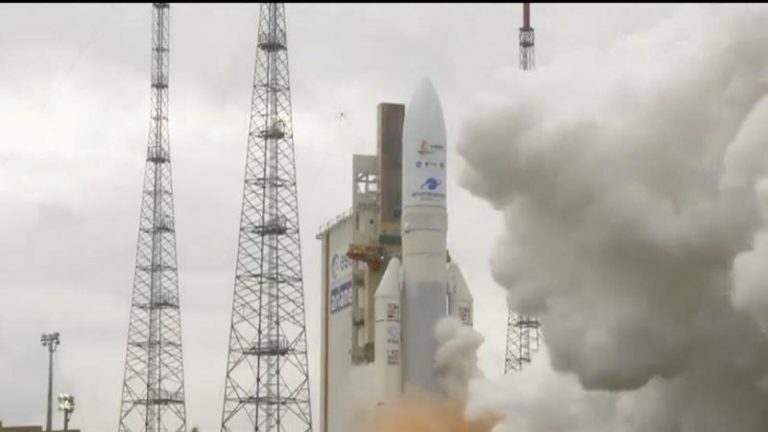
The final launch of Europe’s Ariane 5 rocket from French Guiana has taken place, carrying two military communication satellites. This is the first time European nations have been unable to access space independently for more than 40 years.
On Wednesday, a 53-meter tall, three-stage rocket left the launchpad in the French spaceport Kourou at 7 pm local (2300 GMT). It deployed two satellites according to schedule about 30 minutes later.
In a webcast, Stephane Israel’s CEO of Arianespace said, “Ariane 5’s work is done and Ariane 5 completed its mission perfectly.”
Ariane 5’s 27-year service as a satellite launcher is over with the mission to send Germany’s Heinrich Hertz H2Sat and France’s Syracuse 4B into geostationary orbit. Ariane 6’s successor, Ariane 6, has faced technical delays until 2024 before it can be used for operational purposes.
Ariane 5 was Europe’s heavy-lift launcher of choice until recently. Its 11-tonne capacity, the Soyuz launcher from Russia, and Italy’s Vega rocket for smaller missions were all used.
Moscow withdrew Soyuz access last year amid tensions about Ukraine, and upgraded Vega C is still grounded following the failure of its second December launch. This has sparked what the head European Space Agency called a “space launch crisis.”
In June, the CEO of Airbus (which co-owns ArianeGroup manufacturer with France’s Safran) said that this gap showed Europe’s “vulnerability in space.”
Guillaume Faury, speaking at the Paris Air Forum, said that Ariane 6 is under intense pressure.
Ariane 6’s first test flight is scheduled for the end of this year, depending on the results of tests conducted in the summer. The first commercial launch will be planned for the following year.
Last month, the final launch of Ariane 5 had to be delayed for technical reasons. This week’s delay was due to the weather.
Ariane 6 is a cheaper version of the Ariane 6 that will compete better with SpaceX’s Falcon 9.
The first Ariane 1 launched in 1979 resulted from a development program that began in 1973.
The maiden flight of Ariane 5 in 1996 was a failure. After 40 seconds, the rocket went off-course and self-destructed.
The new workhorse was involved in several milestone launches, including the James Webb Telescope, in 2021 in partnership with NASA, the Canadian Space Agency, and Europe’s Rosetta comet-chasing mission in 2014, which launched a landing probe.