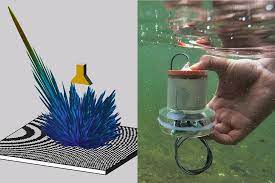
Ambient Sensing showcased sensing technologies developed by several MIT departments and labs. On the left, Associate Professor Ruonan Hans’ reflectarray can focus a beam of terahertz radiation on a small area and control it quickly without moving parts. Right is the underwater sensor of Associate Professor Fadel Adib, which reduces energy consumption by reflecting sound signals rather than producing its own.
Brian W. Anthony, MIT.nano’s Associate Director, said, “Sensing is everywhere.” The MIT.nano Immersion Lab presented Ambient Sensing in May. The event featured MIT faculty members and researchers from various disciplines. It highlighted sensing technology deployed anywhere from below the Earth’s crust to high in the exosphere.
Brent Minchew, an assistant professor at the Department of Earth, Atmospheric, and Planetary Sciences, opened the symposium by presenting on remote Sensing to understand how glacier ice is deformed, fractured, and flows. This information can be used to determine the contribution of sea level rise. Minchew said that there was a “fantastic separation of scales.” We’re using data collected by satellites flying 700 km above the surface to determine what’s happening at the atomic level within the ice. This is a magnificent feat.
Minchew’s team is working with researchers at MIT on a drone that can fly for up to four months in the polar regions. This will fill critical gaps in Earth observation. It’s going to give us a radical improvement in our current technology and observational capability.
Qindan Zhu, a postdoc at EAPS, uses satellites to combine machine learning and observational inputs derived from remote Sensing with studying the ozone over North American cities. Using data accumulated over a decade, Zhu said that controlling nitrogen dioxide emissions would be the best way to control ozone in urban areas. The presentations by Zhu and Minchew both highlighted the importance of ambient sensors in understanding Earth’s changing climate.
Michael Benjamin, Principal Research Scientist in the Department of Mechanical Engineering, spoke about his research on robotic marine vehicles that explore and monitor ocean and coastal marine environments. Benjamin explained that automated platforms could be used as remote sensors to detect areas where crewed vessels cannot. Researchers at the MIT Marine Autonomy Lab are developing underwater surface robots, autonomous sailing vessels, and an amphibious surfing zone robot.
Benjamin said that Sensing is an integral part of marine robots. Without sensors, robots could not know where they were, avoid hidden objects, or collect information.
Fadel Adib is also working with underwater sensors. He is an associate professor in the Department of Electrical Engineering & Computer Science and the Program in Media Arts & Sciences. Adib explained that underwater sensors have a concise battery life. It is difficult to recharge a battery once an ocean sensor has been deployed.
His research team developed an underwater sensor that reflects acoustic waves rather than generating its own. This requires much less energy. The underwater camera was also created. It is battery-free and wireless. Adib discussed the potential applications of underwater ambient Sensing, including climate studies, discovering new ocean species, monitoring Aquaculture Farms to support food safety, and even outside of the ocean in outer space. He said that it is even harder to replace a sensor’s battery once it has been shipped on a mission into space.
James Kinsey is the CEO of Humatics. He has worked in the underwater sensor world for many years. Now he applies his ocean sensors knowledge to two markets: public transportation and automotive manufacturing. Kinsey explained that the value of all the sensor data found in the ocean is only realized when it can be geolocated. Kinsey discussed the automation of vehicle assembly lines, which allows for robotic arms. He emphasized the advantages of using sensing systems in subway trains to know where a train is and to increase worker and rider safety through improved situational awareness. He said that precise positioning can transform the world.
Ruonan Hans, an EECS associate professor, presented his research at the intersection of Electrical Engineering, Communications, and Imaging. He focused on Sensing using semiconductor chips operating at terahertz frequency. Han’s research group has demonstrated high-angular-resolution 3D imaging without mechanical scanning using these terahertz chips. They are working on electronic sensors for gas detection, precision timing, and tags and sensors.
Two Q&A panels, led by Anthony and featuring the speakers, discussed the interface of sensing technologies with the real world. They highlighted challenges in hardware design, manufacturing, packaging, cost reduction, and production at scale. They agreed that hardware and software technology is needed to assimilate and interact with data faster and more immersively.
The MIT.nano Immersion Lab broadcasted Ambient Sensing live. This unique research area, located on the 3rd floor of MIT.nano, provides an environment for connecting the physical with the digital – visualizing data and prototyping advanced tools to create augmented and virtual realities (AR/VR), as well as developing new software concepts and hardware for immersive experiences.
Robert Hupp, a retired MIT fencing instructor, joined Anthony and Praneeth for a live demonstration to showcase the work at the Immersion Lab. A novice fencer, wearing a motion capture suit and AR headset while Namburi tracked his stance using a computer, faced a virtual adversary with the help of wireless sensors attached to the fencing epee. Using this data in real-time, Hupp could show the fencer how to improve their movements.