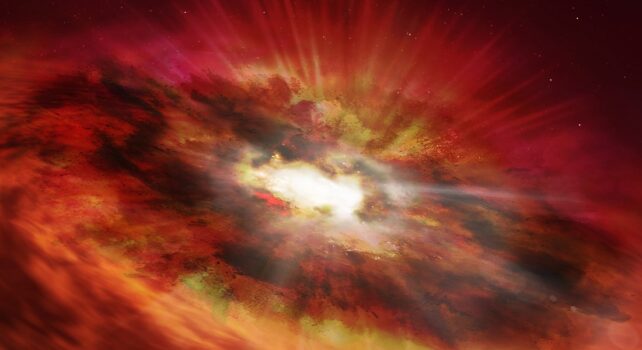
These powerful space winds are emitted from the supermassive Black Holes at Active Galactic Nuclei (AGNs) centers. They are also known as Ultra-fast Outflows (UFOs). “quasars.” This wind (with a funny name!) These winds (with a fun name!) move at speeds close to light speed.
Although they are still not fully understood, these gas emissions are believed to fuel the formation of stars in galaxies. Astronomers want to learn more about these gas emissions to understand galactic evolution better.
The project Super Massive Black Hole Winds in the x rAYS is an international research effort devoted to studying quasars with the ESA’s XMM Newton space telescope.
A group of Italian scholars, led by the University of Bologna and the National Institute for Astrophysics in Italy, shared the project’s first results. The team used X-ray data to describe their findings in a paper.
SUBWAYS is a collaboration between astronomers and astrophysicists at the INAF, ESA’s European Space Astronomy Centre, Space Science Data Center, Centro de Astrobiologia, CSIC-INTA, Center for Cosmology and Astroparticle Physics, NASA/Goddard Space Flight Center and the Netherlands Institute for Space Research.
Recently, a paper titled “X-rays of Supermassive Black Hole X-Ray Winds: SUBWAYS” appeared in Astronomy & Astrophysics.
As they explained, the SUBWAYS team used the X-ray Multi-Mirror Mission to analyze active galaxy nuclei for a period exceeding 1.6 million seconds (eighteen days). The regions around SMBHs are awash with radiation, spanning the entire electromagnetic spectrum.
Extreme temperatures near SMBHs, up to tens of millions of degrees, cause the surrounding material to be highly ionized. This radiation is then emitted.
When dust and gas from the SMBH’s accretion disc are ejected, they transfer some material and energy to interstellar spaces. This mechanism is essential for the regulation of star formation, according to research.
The team analyzed the high-energy spectra emitted by iron in the X-ray band to get a closer look at UFOs. The team studied 17 AGNs located between 1.5 and 5 billion light-years away. They also added data collected from five AGNs by previous observations.
The researchers found that space winds were present in 30 percent (or 0.1 to 0.3c) of the analyzed AGNs. Marcella Brusa is a professor and INAF Associate at the University of Bologna. She coordinates the SUBWAYS Project.
There is a mutual relationship between an SMBH and the surrounding galaxy. The two have a reciprocal influence on each other’s evolution and formation.
The ultra-fast AGN wings are believed to be a critical factor in this relationship.