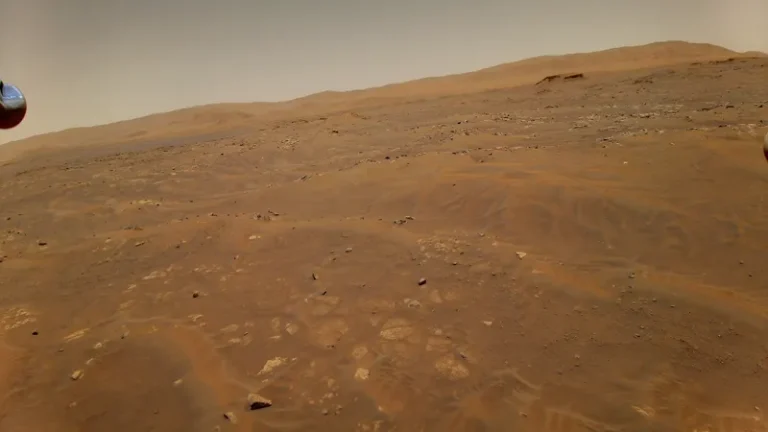
Researchers analyzing images and data from Perseverance’s rover on Mars found organic molecules in Jezero Crater. This could provide evidence about the carbon cycle of the planet and its ability for life.
It is not proof that there was life on Mars in the past, but rather a sign of conditions that were once present. Perseverance investigates many aspects of Mars, but the most important is whether it once hosted life.
Researchers found organic molecules in ten targets that Perseverance examined with its SHERLOC (short for Scanning of Habitable Environments using Raman and Luminescence for Organics, Chemicals, and Chemicals) instrument. Nature published the team’s research on organic-mineral association around Jezero.
Perseverance has been roaming around the western end of Jezero Crater since it landed on Mars in February 2021. The rover collected rock samples since then. If all goes according to plan, we should be able to bring the pieces back to Earth by the early 2030s.
Perseverance, however, is not just about rock collecting. Scientists use cameras on the rover to study the Martian landscape. Perseverance’s SHERLOC camera provides new insights into Martian rock chemistry.
In an email sent to Gizmodo, co-author Joseph Razzell Hollis said, “Our results confirm observations made by previous robotic missions that the Red Planet once was rich in organic materials, compounds primarily composed of carbon and hydrogen.” Each detection and each observation gives us more information to help us understand the history of Mars and whether or not it supported life at one time.
Perseverance’s SHERLOC instrument uses Raman and Fluorescence spectroscopy and takes images. These two methods reveal the molecule composition of Martian rocks and the distribution of minerals and molecules across the stone’s surface. These analyses provide scientific data and do not harm the rock. This is especially useful for a rover trying to send its rock samples back to Earth within the next decade.
Scientists believe that if life existed in Jezero Crater, it would have populated the crater’s western rim, which is a delta. Stromatolites are 3.5 billion-year-old fossilized microbial matrices that appear in similar shallows. Water had flowed into Jezero’s crater for at least a thousand years, and organic molecules sat on its subaquatic surface. This was an ideal environment for life.
The team could not date the molecules. Still, Hollis stated that “some of our signatures that are consistent with organics are associated with minerals which were altered by water 3-4 Billion years ago.” This suggests that a complex geochemical process could have been in action on Mars and that at least some building block for life may have existed.
There’s still a way to go before we find the smoking gun Bowie ruminated about, but it’s unlikely there will ever be one.
Abigail Allwood is an astrobiologist and geologist who is the principal investigator for Perseverance’s PIXL Instrument. She told Gizmodo 2021: “You have to have multiple scales of observations, which all need to be pieced together into a complex pattern, from which you can interpret ‘these things have to have been biological in a way.’
The recent confirmation of organic molecules in Jezero Crater fuels the fire. The fact that they are there makes that possibility more plausible if it is not even conceivable.
Hollis explained that claiming life as the source of organics and possible biosignatures was a “last resort hypothesis,” meaning we must first rule out non-biological causes.
He added: “We are fascinated by these signals because they could be organic and point out that building blocks of the life on Mars could have existed for a very long time, in multiple places.” We will have to bring these samples back to Earth to conclusively confirm the presence, type, and mineral association of organic molecules.
The bad news is we need to wait for the Mars Sample Return mission before we can get a better idea of the possible existence or not of the Jezero Crater. The good news is there’s still a chance.