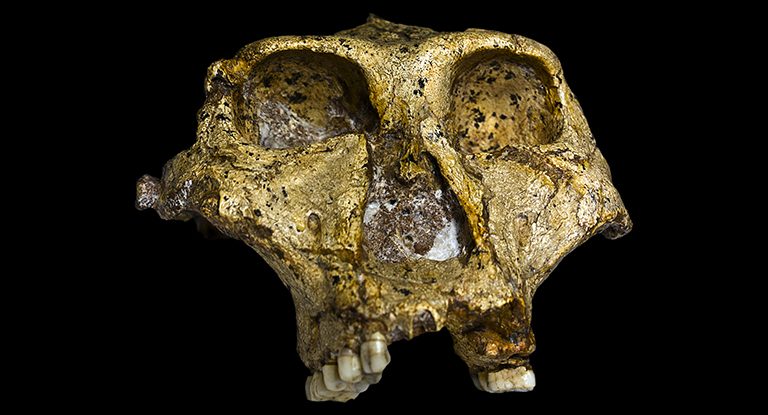
Researchers have achieved the remarkable feat of predicting the genetic relationships between the oldest hominins living on Earth using only a few proteins from fossilized teeth dating back 2 million years.
Researchers led the new study from the University of Copenhagen, Denmark, and the University of Cape Town, South Africa. They say the analysis is vital in tracing the distant human family tree.
The researchers write that “the evolutionary relationships between extinct African hominin species are highly debatable and largely unresolved due to a lack molecular data.”
“Even among taxa, it’s not always obvious, based solely on morphology, whether the ranges of variations are due to sexual diversity or undescribed taxonomic variety.”
This research will allow paleoanthropologists to determine which differences between the fossils are due to sexual dimorphism and which represent separate species.
Answering these questions for thousands of millions of years takes work. The DNA molecule can disintegrate quickly. The nuclear DNA of 430,000-year-old hominin remains was deciphered. However, the process itself could have been more productive.
It can make proteins more robust, and the amino acid sequences of these proteins can be translated into a genetic code that produces them. It is not precise, but it can be used as a proxy to estimate a genetic relationship when the genes cannot be read.
In this case, the data was interpreted from enamel on teeth found at Swartkrans Cave. This important archaeological site is located about 40 kilometers away (25 miles) northwest of Johannesburg. These teeth were believed to be from an ancient relative, Paranthropus ruggedus.
The researchers confirmed that P. The researchers could tentatively show that P. robustus was an “outgroup,” or distant cousin in a sense, of the evolutionary line, which includes Homo Sapiens, Neanderthals, and Denisovans.
The team believes that flash floods in a dry area caused the teeth to be buried deeply and preserved. This may limit the number of fossils we can find, but these techniques should work anywhere.
The researchers write that “this study shows the feasibility of recovering informative Early Pleistocene Hominin Enamel proteins from Africa.”
“We anticipate that this approach can be widely applied to geologically-comparable sites within South Africa, and possibly more broadly across the continent.”