The demand for ultrastable and high-resolution X-ray imaging in medical diagnostics and astronomical research has sparked a passionate search for innovative X-ray-responsive materials. The materials that are sought after must have exceptional properties such as high attenuation of X-rays, efficient scintillation, and rapid light decay. Lead-halide-based materials have been a strong contender because of their high luminescence, superior X-ray attenuation, and short lifetimes for fluorescence. However, Their application in the scintillation field is hindered due to the toxic heavy metal lead (Pb), the low photon yield caused by self-absorption, and the poor X-ray irradiation stability.
Breaking barriers with lead-free antiperovskite Nanocrystals
Researchers have been searching for solutions to these problems in lead-free zero-dimensional metal halides, including copper, silver, zirconium, and manganese halides. These fascinating alternatives have proven to be effective scintillators, offering high photon yields, diverse compositions and structures, and a unique luminescence system known as self-trapped excitons. The fabrication of thin films and wafers is challenging, resulting in poor imaging resolution because of light scattering from large particles or crystal boundaries. Lead-free 0D halides also face problems with poor stability in humid and hot environments.
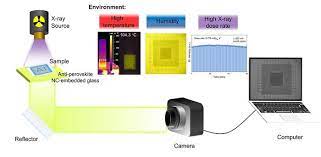
Researchers from the South China University of Technology have developed an innovative approach to X-ray images that is revolutionizing the field. The researchers achieved high-resolution, ultra-stable imaging in high humidity and temperature conditions. Lead-free Cs 3MnBr 5 antiperovskite microcrystals are embedded in a glass matrix.
Antiperovskites, unlike traditional perovskite material, possess a unique structure that is represented by [MX 4]XA 3 (A = alkali metallic; M = transitional metal; and I = iodine(I)), chlorine (Cl), or bromine (Br). This unique configuration features a luminescence center, the [MX 4] 2- tetrahedron nestled inside a three-dimensional ( 3D) XA 6 octahedral Antiperovskite skeleton. This structure reduces the interaction between the luminescence center, which leads to enhanced spatial confinement and high luminescence stability.
The Mn 2+ ions, integrated during the annealing process, give rise to luminescence colors that can be adjusted from red to green depending on the annealing program. The Cs 3MnBr 5 nanocrystal embedded glass also exhibits unmatched X-ray stability, thermal stability, and water resistance. It also has an outstanding X-ray detection limit (767 micrograys per sec), an impressive spatial resolution for X-ray imaging (19.1 pair of line pairs per millimeter), as well as an outstanding X-ray dose irradiation (5.775 milligrays/sec).
This pioneering work introduces an exciting new scheme for harnessing the potential of transparent glassy nanocrystals that incorporate lead-free antiperovskite halide nanocrystals in high-resolution, ultrastable applications. This research could act as a catalyst for further exploration and development in novel metal halide-anti-perovskite material. This discovery will pave the way for future development of next-generation X-ray devices. It promises transformative advances in the field of imaging and diagnostics.