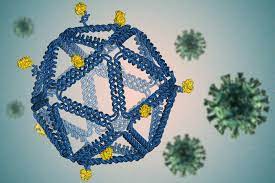
Bioengineers found a new way to control the size and shape of virus particles. They did this by combining viral proteins and DNA templates. The resulting nanostructures could be used to develop vaccines and transport drugs within the body.
The virus capsid protein- the proteins that protect the virus’s genome- can be used to create precisely structured protein assemblies. The virus strain primarily determines the shapes and geometries of these assemblies. The possibility of reprogramming viral groups is intriguing for developing vaccines and drug delivery.
Scientists solved the problem by creating a “structured gene” template to assemble capsid protein. They used rigid DNA origami to avoid deforming the genome and creating unwanted shapes. The structures are only a few tens or hundreds of nanometres long but are made entirely of DNA.
We can use DNA origami to direct capsid protein into a user-defined size and shape. This results in well-defined assemblies, both in terms of length and diameter. We also learned that the geometry of the templates affected the entire body by testing different DNA origami shapes,’ Seitz says.
Professor Juha Huiskonen from the University of Helsinki, who was a collaborator, explained that they were able, using cryogenic electron microscope imaging, to see the highly-ordered proteins during assembly and measure the slight differences in the geometry of body due to different templates.
We have developed a simple but effective strategy for (re-)directing capsid protein to the desired shape. As we have shown with capsids from four different virus types, our approach is adaptable. Additionally, we can tweak our template to be more application-relevant, for instance, by integrating RNA into the origami, which could subsequently be translated into functional or site-specific proteins,’ explains Aalto professor Mauri Kostiainen, leader of the research project.
They are unstable, particularly in the presence of DNA-degrading enzymatic agents.
In experiments, we can see that the protein layer effectively protects the encapsulated nanostructures of DNA from degradation. Our approach offers interesting new directions in biomedical engineering by combining the protection of nucleic acids origami with its functional properties, such as the ability to deliver messenger RNA or DNA with other cargo molecules.
The research was carried out jointly by researchers from Aalto University in Finland, Griffith University (Australia), Tampere University in Finland, and the University of Twente in the Netherlands.