The Night Sky This Week – October 16-22, 2020
This week, after last week’s excitement surrounding the annular “ring of Fire” solar eclipse, you might be feeling a bit like a hangover. The crescent Moon will be visible in the twilight sky after last week’s antics. The Orionid Meteor Shower is one of the most spectacular displays of shooting stars from Halley’s comet.
Monday, October 16, Spot A Slender Circular Moon
You can find an impossible-slim crescent moon by looking southwest shortly after sunset. Binoculars are the best tool to locate the crescent Moon that is two days old. It will only be 5% lit.
Tuesday, October 17, Crescent Moon approaches Antares.
After dark, look southwest, and you will see a waxing crescent moon with 10% illumination approaching the bright supergiant Antares. This is the shining star of the constellation Scorpius. About 500 light years away from our solar system.
Wednesday, October 18, ‘Earthshine,’ Moon And Antares
The crescent Moon is now 18% lit, but it will be close to Antares tonight. This red supergiant is located about 500 light years from our solar system. Earthshine, the sunlight reflected by Earth’s oceans or ice into space, should be visible on the Moon.
Saturday, October 21: Orionid Meteor Shower Peaks
The Orionids are at their peak when the first quarter moon is gone by midnight. Those who stay up through the night on Friday and Saturday can see 10-20 shooting stars per hour.
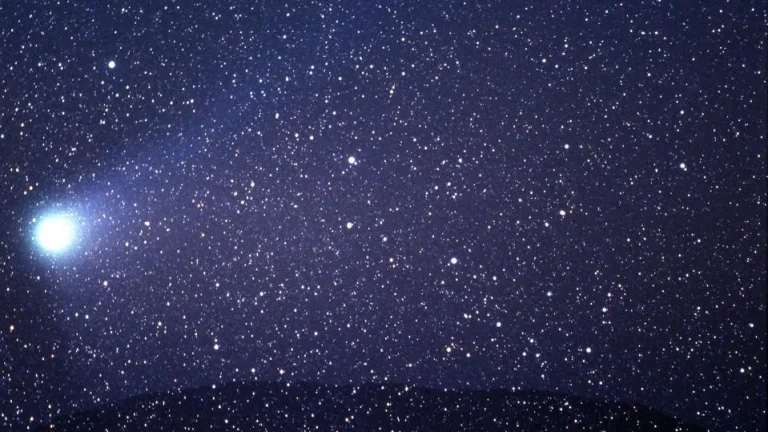
The Orionids is one of the two annual meteor showers that Halley’s Comet causes.
Halley’s Comet, last seen in 1986, will reach its furthest point from Earth in December, after Neptune. It then begins its long journey to loop back around the sun in 2061.
Eris is this week’s dwarf planet of the Week.
Pluto is a planet. It is not a planet, nor has it been since the early 20th century, when other bodies of similar size were discovered in the outer solar systems. Eris is one of the bodies that will reach opposition this week in Cetus.
The Earth is now in opposition to Eris. This means that the dwarf planet will be brighter than ever from our perspective at night when we are looking out into the Solar System. You will need a big telescope to see Eris. Ceres is the other dwarf planet in our solar system. Pluto and Eris are also there.
Object of the Week: Magellanic Clouds
Even in the clearest skies, you may see a few clouds. The Large and Small Magellanic Clouds are a pair of dwarf galaxies that orbit the Milky Way.
If you are heading south, take some binoculars–there’s a lot to see in the LMC and SMC. Take binoculars if you’re heading south. There is much to see at the LMC and SMC.