Not all ecosystems built deep under the sea are alike.
A team of international scientists has discovered that the ocean’s deepest depths are dominated by one particular type of organism. Most creatures that lurk in the dark below a depth of 4,400 meters (14 436 feet) have soft and squishy bodies. Only above this line are hard-shelled shelled mollusks found.
Scientists believe that the reason for this is the mineral availability from which shells can be formed. This information could be used to protect biodiversity from human activity in cold, dark, and eldritch habitats.
The National Oceanography Center’s Erik Simon-Lledo, a deep-sea ecologist, says that muddied abyssal ocean floors were considered marine desserts’ in the early days of exploration. They had extreme temperatures, high pressure, and a lack of food.
As technology and profound exploration progress, these ecosystems reveal a large diversity, similar to that found in shallow water ecosystems, but on a wider spatial spread. The abyssal sea is more significant than 60%, yet little is known about the living creatures. The environment is hostile to humans, with its crushing pressures and freezing temperatures.
The technology has advanced to the point where we can now remotely explore the darkest depths of the earth, revealing its strange pale and soft underbelly.
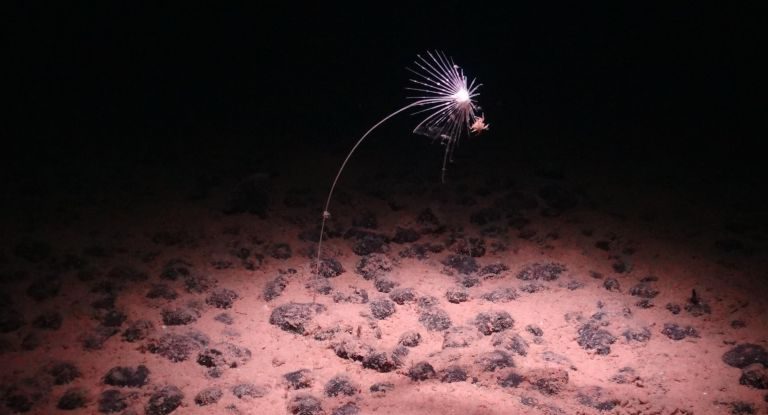
Simon-Lledo’s team, using deep-sea robotics, collected a database of images of an abyssal flat called the Clarion-Clipperton Zone. This zone extends 5,000 km (3,107 mi) to the bottom of the Pacific Ocean, between Mexico and Kiribati, at depths ranging from 3,500 meters to 6,000 meters.
The researchers cataloged over 50,000 a href=”https://www.nature.com/articles/1771105a0″>abyssal creatures/a>. They noticed pronounced differences between the types of animals found at shallower depths and those in the deepest parts of the zone. They cataloged more than 50,000 creatures of the abyss and noticed that the animals in more external factors of the site were different from those in deeper areas.
Mollusks with their hard shells did not appear below 4,400 meters, but all abyssal creatures populated the transition zone between these two regions. The researchers concluded that this depth is likely related to the Carbonate Compensation Depth.
Hard shells form Calcium Carbonate. This calcium carbonate diffuses throughout the ocean. However, more calcium carbonate is needed to support hard-shelled animals.
This indicates that the deep ocean is a fragile ecosystem, which climate changes and deep sea mining could easily disrupt. The Clarion-Clipperton Zone, currently being considered, would fall into this category.
The researchers explain in their paper that “Overall, the results show a higher level of ecological heterogeneity at multiple scales than previously thought for benthic communities across the northeast Pacific’s abyssal ocean floor.”
This overlooked heterogeneity, resulting from geochemical and climate forcing, has important implications for future macroecological and ecological research in the abyssal community and for regional-scale conservation strategy implementation to protect biodiversity in Clarion-Clipperton Zone and likely in other abyssal regions targeted by deep-sea mines worldwide.