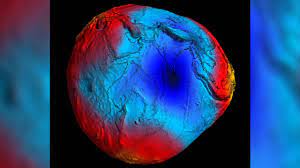
In the Indian Ocean, there is a “gravity-hole” — an area where the Earth’s gravity is weaker and its mass is lower. The sea level has also dropped by over 100 meters.
The formation of this anomaly puzzled geologists long ago. But now, researchers at the Indian Institute of Science, Bengaluru in India, believe they have a plausible explanation: magma plumes from deep within the planet.
The team simulated the formation of the area using supercomputers, dating back to 140 million years. The findings, described in a recent study in Geophysical Research Letters, center around an ancient ocean that no longer exists.
A disappearing ocean
Earth is not a perfect sphere as we think.
Attreyee, a geophysicist at the Indian Institute of Science’s Centre for Earth Sciences and an associate professor there said that the Earth is essentially a lumpy potato.
It’s technically not a sphere but an ellipsoid because the middle bulges as the planet rotates.”
Ghosh said that our planet’s density and properties are not homogeneous, and some areas are more dense than others. This affects Earth’s surface and gravity.
She said that pouring water onto the Earth’s surface will take a certain level. The density of the materials inside the planet determines this. They attract the surface differently depending on how many masses are underneath.
The Indian Ocean’s “gravity hole,” also known as the Indian Ocean Geoid Low, is the lowest point of the geoid. It is its most significant gravitational anomaly. This circular depression begins just off India’s southern tip. It covers approximately 3 million square kilometers.
The anomaly, discovered in 1948 by Dutch geophysicist Felix Andries Vening Meinesz during a gravity study from a ship and a mystery to this day, was first noticed by Dutch geophysicist Felix Andries Vening Meinesz.
Ghosh stated that the problem needed to be adequately explained.
Ghosh and her colleagues used computer models to look at the geological picture from a larger perspective.
She said, “We know a little bit and are confident about the Earth’s appearance at that time.”
The continents, oceans, and density structure were all very different.
The team then ran 19 simulations, up until the present, to recreate the shifting of the tectonic plate and the behaviors of magma or molten rocks inside the mantle, which is the thick layer between the Earth’s core and crust. In six scenarios, a low geoid similar to that in the Indian Ocean was formed.
Ghosh said that the main difference between the six models is the presence of plumes around the geoid-low. These, along with the mantle structure nearby, are thought to be responsible for forming the “gravity hole.”
When the magma density was varied, simulations were performed. In those where the plumes weren’t present, the low didn’t form.
Ghosh explained that the plumes were created by an ancient ocean disappearing as India’s landmass moved and collided with Asia millions of years before.
“India was in an entirely different place 140 millions years ago. There was a large ocean between the Indian Plate and Asia. As India moved north, the ocean vanished and closed the gap between Asia and India,” explained she.
The oceanic plate could have pushed low-density materials closer to Earth’s surface as it sank into the mantle.
The geoid low and its future
According to the team’s calculations, it formed around 20 million years ago. Predicting whether the geoid low will disappear or move away is difficult.
Ghosh explained that it all depends on the way these anomalies move.
It could persist for a long time. Plate movements will make it disappear in a few hundred million years.
Huw Davies is a professor at Cardiff University, UK. He said the research was “fascinating and described interesting hypotheses which should encourage future work on this subject.” Davies was not involved in the study.
Dr. Alessandro Forte is a professor of Geology at the University of Florida, Gainesville, who was not involved in the study. He believes there are good reasons to perform computer simulations to find the origin of Indian Ocean Geoid Low, and this study is an upgrade over previous ones.
In the past, research has only included the cold mantle material that descends across it. It did not include the hot mantle plumes rising.
Ghosh stated that the simulations cannot take into account every factor.
“We don’t know exactly how the Earth was in the past.” She said that the more back in time one goes, the less confident she was in the models.
We cannot consider every scenario. There may also be discrepancies in the way the plates move over time.