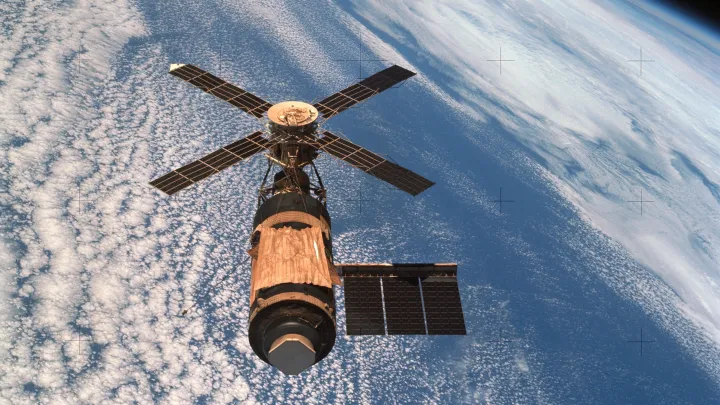
The 50th anniversary marks the launch of NASA Skylab, the space station which laid the foundation for the International Space Station. The orbital laboratory is remembered today for the hysteria that it caused before it crashed into Earth. But it’s also important to reflect on the historical legacy of the space station.
Skylab, the first U.S. station in low Earth orbit, was launched on May 14, 1973. During its brief life, the orbiting lab was manned by only three astronauts, but each mission broke records for the duration and provided unprecedented scientific and technological data. As NASA noted ten years ago, Skylab proved that “humans could live and work in space for long periods of time.”
Simple Start
Skylab, parked in low Earth orbit, traveling at 25750 km/h around the planet, allowed detailed observations of Earth and the Sun. It also served as a laboratory for medical experiments and a platform to study the effects of prolonged spaceflight. The main components of the Skylab were the Apollo telescope mount and airlock module. Skylab’s main goal was to reuse as much Apollo hardware as possible.
In a NASA report from 1977, Rocco Pétrone, NASA’s Marshall Space Flight Centre director from 1973 to 1974, wrote that “the program required innovation and ingenuity.” The knowledge and experience gained through earlier space programs was a good foundation, but Skylab Program truly paved new paths in the skies.
Space exploration: a new Age begins
Skylab was launched into space on May 14, 1973, from NASA’s Kennedy Space Centre aboard a Saturn V Rocket — the same rocket type that took Apollo astronauts to Moon. The launch was with the incident. Vibrations caused the station’s thermal and micrometeorite shield to fall off after 63 seconds.
In a 2020 retro, NASA’s John Uri wrote: “Debris from torn shields jammed one array, preventing its opening. A plume from the retrorocket that separated Saturn V’s 2nd stage from Skylab impinged the second array in its slightly opened configuration, tearing the station completely off.”
This caused severe power problems at the station, which required immediate attention by the first crew that launched Skylab that same month. This meant that Skylab’s workshop, which was unprotected from the Sun’s harmful rays due to the missing thermal shield, would also be unprotected.
Fabricating a replacement heater shade
After the security was destroyed, NASA had to rush to replace the heat shield for the Skylab Orbital Workshop. The temperatures inside Skylab reached 52 degrees C. NASA engineers developed a solution and then trained the first crew to fix the problem. Above is a picture of a team assembling the heat shade at the GE Building across from Johnson Space Centre, Texas. The parasol solar screen, made of layers of aluminized nylon ripstop and thin nylon, protected the workshop against the Sun’s hot rays.
Launch of the first Skylab Crew
Skylab 2 was the first crewed space station mission, while Skylab 1, the task that launched the station into orbit, was called Skylab 1. This confusion led to original mission patches referring to crewed missions 1 through 3. The first crew of Skylab was launched on May 25, 1973, by a modified Saturn V rocket called the Saturn IB. (The team had been scheduled to tackle the day after Skylab achieved orbit, but the problem with the launch caused a delay).
The first crew comprised the commander Pete Conrad and pilot Paul Weitz. Joe Kerwin, a scientist, was the first medical practitioner to fly into space. Above is a photo of the Saturn IB positioned atop NASA’s “milk stool pedestal.”
It’s not there!
The first Skylab crew took this image upon arrival. It shows the partially deployed solar array and the micrometeoroid shield that had been removed. The harsh sun rays were already discoloring and blistering the exposed skin in the workshop. Uri wrote that the newly arriving crew could see the thin aluminum stripe holding the first array in a partially open position and a tangle where the second panel had torn.
The crew would then install the parasol solar shade as a makeshift mission shield and repair the solar array in a series of spacewalks. Before the fix, Skylab was powered by four smaller ATM panels, but this wasn’t enough for the station’s experiments and systems.