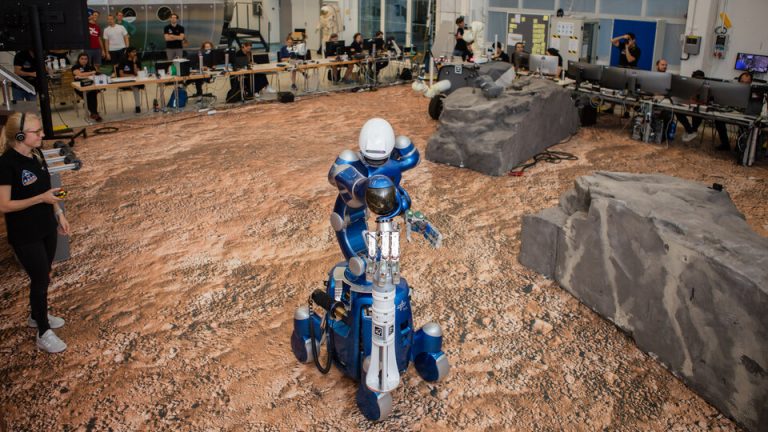
The two-hour telerobotics demonstration occurred at the German Aerospace Center DLR in Oberpfaffenhofen, near Munich. NASA astronaut Frank Rubio, working from Europe’s Columbus Module, directed a trio of robotic assets to remove the seismometer on a lunar lander and place it on the ground to detect moonquakes.
Frank was the supervisor for the robot team. He worked on a point-and-click basis. He could take control of the robot using a force feedback device. A DLR robotic lander was combined with DLR’s Rollin’ Justin robot and ESA’s two-armed, four-wheeled Interact rover.
This study aims to determine what astronauts require when they operate robots with varying degrees of autonomy, also known as “scalable autonomy.” This allows astronauts to be in greater control of the robots.
Justin had to remove a pin from the lander to place the seismometer. Justin had to retrieve the sample that was still stuck in the gripper of the Interact rover after it had been damaged during a surface-sampling operation by an earthquake.
Frank completed all tasks on time and gave the team helpful feedback about the features of the user interface and robots. These will be implemented in Surface Avatar’s next session in January 2024.
The first test paves the way for a second Surface Avatar testing with a bigger team of robots. This test is planned by Danish ESA astronaut Andreas Mogensen on his Huginn mission later this year.
It is impossible to remotely control robots on the Moon or any other planet’s surface from Earth due to the distances involved. The idea is that astronauts in space will handle the robots, allowing them to explore the Moon and other alien environments without having to land or incur the costs and risks of doing so.
The METRON project, undertaken in partnership with DLR, demonstrated the feasibility of force-feedback controls from orbital space. It expanded to astronauts aboard the ISS and culminated in an outdoor campaign on Mount Etna, a lunar-like terrain in Sicily.
Surface Avatar combines direct teleoperation with supervised autonomy to control multiple robot assets and accomplish complex tasks. Imagine a construction site on Earth where a crane could work alongside an excavator or bulldozer to complete an enormous task.
We are trying to determine how astronauts perform when they’re in the field. What mode of control do they select? Can they see the world from the perspective of robots and have situational awareness? What decisions do they make about what to do?”
Surface Avatar assumes a relatively structured surface base environment, where robots are already familiar with the various objects and robots around them. An augmented reality display will then present a list of choices for the controller.
The astronaut can switch to direct control if the option isn’t available. They will feel exactly what the robot feels through a force feedback control device. This allows for a high degree of precision.
“We are thrilled to be a small step closer to giving astronauts and experts from Earth a variety of options to manage and command teams of robots in space,” said Principal Investigator Neal Y. Lii of the DLR Institute of Robotics and Mechatronics. We can use our robots as intelligent co-workers and their physical avatars to perform more complex tasks.
Thomas agrees: “This human-robot cooperation paves the way for future missions and permanent outposts on and beyond the Moon.”