Coral scientists face the dilemma of deciding which coral species and how many will be supported by cutting-edge research on reef restoration.
Scientists worldwide have developed a method to select coral species that can be restored to damaged reefs.
The findings of the researchers, published in the Journal of Applied Ecology today, will help guide decision-making in reef restoration programs worldwide, including Australia’s Reef Restoration and Adaptation Program and Australian Coral Reef Resilience Initiative.
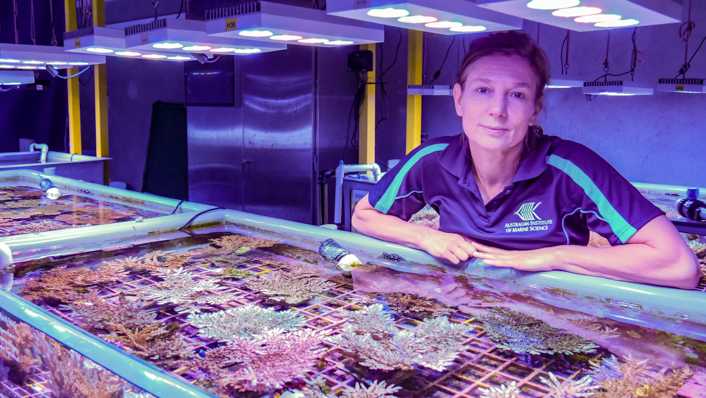
Professor Madeleine van Oppen is the senior author of the article. She comes from the University of Melbourne and the Australian Institute of Marine Science.
“Current coral restoration programs are largely focused on fast-growing, easy-to-collect coral species that have similar characteristics but cannot support ecosystem services by themselves.”
Professor Dr. Joshua Madin of the Hawai’i Institute of Marine Biology is the lead author of this study. He said ensuring species diversity and ecosystem functions in future coral reefs was essential.
Researchers combined databases of traits from corals in Australia’s Great Barrier Reef, with their ecological characteristics, including their resistance against thermal bleaching, to determine how to best select species for restoration, using a similar hedging strategy to that of investment portfolios.
“Selection on the basis of ecological characteristics is essential for protecting against future species losses, while trait diversity is crucial for protecting against the loss certain ecosystem services, such as reef-building groups, categories for life histories, and evolutionary variation,” said Dr Madin.
This simple approach will help restoration practitioners select suitable species based on resources and spatial scale for their project.
The University of Hawai’i wrote the paper following a workshop organized by U Melbourne and AIMS.
Selecting Species for Restoration, Journal of Applied Ecology:
Funding:
The Australian Research Council, Defense Advanced Research Projects Agency, and National Science Foundation funded this project. Also, the Reef Restoration and Adaptation Program is funded through a partnership between the Australian Government’s Reef Trust and Great Barrier Reef Foundation.