Robots are used in places where humans cannot go. Robotic support is, therefore, essential for space exploration missions. The interaction between humans and robotics will be even more crucial in future missions.
Researchers at the German Aerospace Center are working on critical technologies, such as telepresence robots, for space exploration. This includes the Moon and Mars. It will be possible to command robots in space from a spacecraft’s orbit.
DLR’s Surface Avatar mission team has demonstrated this. Astronaut Frank Rubio controlled robots from the International Space Station to complete a complex task. They could act autonomously or partially, depending on what was required.
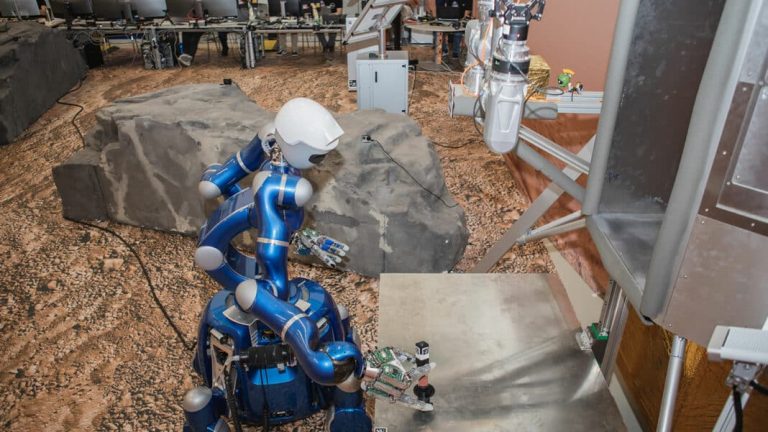
The DLR’s Oberpfaffenhofen, near Munich, conducted a two-hour test of telerobotics in a simulated planetarium. Frank Rubio, who controlled three robots on the Columbus module from the ISS, removed a seismometer attached to a lunar lander to place it on the ground for moonquakes. A DLR robotic arm was used with DLR’s Rollin Justin humanoid Robot and ESA’s four-wheeled two-armed Interact Rover.
Justin had to remove a pin from the lander in the test scenario before Justin could position the seismometer. Justin had to retrieve the sample that was still stuck in the gripper of the Interact rover after an earthquake damaged it during a surface-sampling operation.
Rubio can have a robot complete a task autonomously by pressing a button. The astronaut could take control of the robot by using an avatar and perform individual steps as he did. He had the Robot Command Terminal at his disposal, which combined three different control elements.
He could control the robot’s movements using a joystick and ‘feel’ what it ‘felt,’ thanks to a force feedback interactive device.
The test was part of a more extensive ‘Surface Avatar series’ of tests. The trial opens the door to a Surface Avatar follow-up with a bigger team of robots that will be conducted by Danish ESA astronaut Andreas Mogensen on his Huginn Mission later this year.
Surface Avatar envisions three experiments every six months. DLR’s Bert, a robot that can traverse rough terrain using its doglike body and four legs, will join the team.
NASA and ESA will likely be operating in real-life scenarios in the future. It is intended that astronauts will control the robots from orbit, allowing them to explore the Moon and other alien environments without having to land.