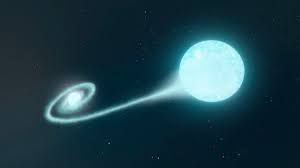
Stars like our Sun tend to die with a whimper, not a bang, unless they are part of a binary system (two stars) that can cause a supernova.
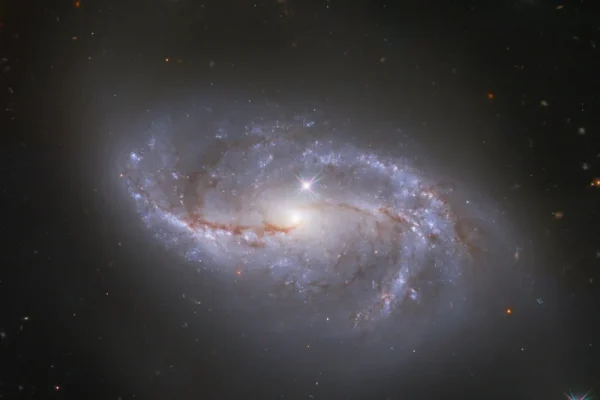
Astronomers have now, for the very first time, detected the radio signature of a similar event in a galaxy located more than 400,000,000 light-years from Earth. The discovery, published in Nature Today, provides tantalizing clues about what the companion star would have looked like.
An explosive star death
This process produces the colorful clouds of gas that are mistakenly called a href=”https://theconversation.com/extreme-stripping-action-led to-the messily birth of the southern ring nebula – webb image reveals-196052″>planetary nebulae/a>, and leaves behind incredibly dense, compact hot cores known as white dwarfs. This gives rise to the colorful gas clouds mistakenly called planetary Nebulae and leaves behind an intense, burning heart known as a White Dwarf.
In about 5 billion years, our Sun will go through this transition, cool down, and slowly fade away. If a white dwarf gains weight, the self-destruct system kicks in once it reaches 1.4 times our Sun’s mass. A Type Ia Supernova is a unique explosion that results from the subsequent thermonuclear blast.
Where would this extra mass come to power such a boom?
We thought gas was being ripped off a giant companion star in close orbit. Gas is often spewed everywhere by celebrities, who are messy eaters. Supernova explosions would cause any gas to glow in radio wavelengths. Despite decades of searching, radio telescopes have never detected a young Type Ia Supernova.
We began to believe that Type Ia supernovae are pairs of white dwarfs merging inwards relatively cleanly, with no gas left to shock and no radio signals.
Rare Type of supernova
Supernova 2020eyj was discovered using a telescope located in Hawaii on 23 March 2020. It behaved like any Type Ia Supernova for seven to eight weeks.
It stopped dimming in brightness for the next five months. Around the same period, it began to display features that indicated gas with an unusually high helium content. Supernova 2020eyj was suspected of belonging to a subclass of Type Ia Supernovae where the blast wave moves at speeds exceeding 10,000 km/s and sweeps gas that can only be stripped from the outer layers of a surviving companion.
We confirmed our suspicion by testing if enough gas was being shocked to produce a signal. We used a network of radio telescopes across the United Kingdom instead, as the supernova was too far north to observe using telescopes such as the Australia Telescope Compact Array in Narrabri.
We were pleasantly surprised to discover that we had made the first-ever radio-wave detection of a “baby” Type Ia Supernova. This was confirmed by another observation five months later. Could this be “the smoking gun” that Type Ia supernovae do not always result from the merger of white dwarfs and black holes?
Patience pays off
One of the most remarkable things about Type Ia supernovae is that they all seem to reach the same brightness peak. This is consistent with all going the same critical mass before exploding.
In the late 1990s, astronomer Brian Schmidt’s team reached the Nobel Prize-winning conclusion that the universe’s expansion since the Big Bang does not slow down due to gravity (as was expected) but accelerates because of the effects we now call Dark Energy.
Astronomers are concerned about Type Ia supernovae because they’re essential cosmic objects. We have yet to determine how or when these stellar explosions happen, nor what makes them so constant.
Why should pairs of merging White Dwarfs, which can have a total mass as high as three times that of the Sun, release the same amount of energy?
This consistency can be explained by our hypothesis (and confirmation via radio) that Supernova 2020eyj was caused when enough helium from the companion star was stripped and deposited on the surface of the White Dwarf to push it over the mass limit.
We must ask ourselves why we’ve never seen this radio signal in other Type Ia Supernovae. We may have given up too quickly after we failed to detect the radio signal. Not all companions are as helium-rich and prolific in shedding the gaseous layers of their outer layers.
As our study showed, patience and perseverance can sometimes pay off in ways that we would never have expected. They allow us to hear dying whispers from a distant star.