EAST LANSING (Mich.) – Sometimes, the best way to conceal a secret in broad daylight is by hiding it. Ask the sun.
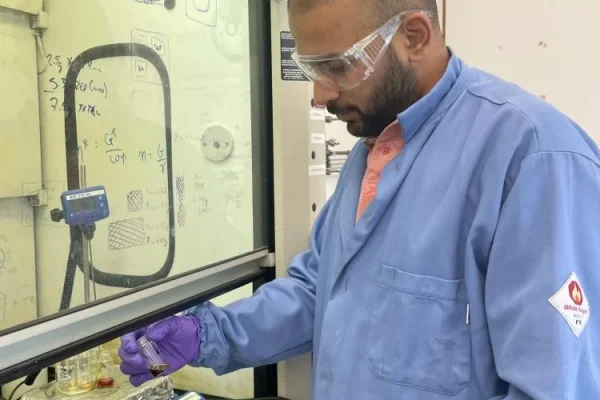
“The sun surprises us more than we thought,” said More Un Nisa, a postdoctoral researcher associate at Michigan State University. “We thought that we understood this star, but it turns out to be incorrect.”
Nisa is the co-author of a paper published in Physical Review Letters, which details the discovery and measurement of the highest energy light from the sun.
The international scientists behind the discovery found that gamma rays are also surprisingly bright. Scientists had underestimated the amount of gamma rays.
Watching like a HAWC
Nisa and colleagues detected the signatures of these gamma rays using the High-Altitude Water Cherenkov Observatory (HAWC).
HAWC, funded by the National Science Foundation and the National Council of Humanities, Science, and Technology (NCHST), plays a vital role in the story. It is unlike other observatories in that it operates around the clock.
Nisa works at the Department of Physics and Astronomy of the College of Natural Science.
She said, “In this energy regime other ground-based telescopic telescopes could not look at the Sun because they only worked at night.” “Ours operates 24/7.”
HAWC is different in terms of how it works and looks very different.
HAWC does not use a tube with lenses but a system of 300 large tanks filled with 200 metric tonnes of water each. The network nestles between two dormant volcanic peaks in Mexico at more than 13,000 ft above sea level.
It can see the impact of gamma rays on the air. These collisions produce air showers that look like small particle explosions but are invisible to the naked eye.
The original gamma-ray energy is released and redistributed to new fragments of lower energy particles and lighter light. HAWC “sees” these particles and the new particles that they create as they descend.
The Cherenkov radiation is created when the shower particles interact in the water tanks of HAWC. The observatory instruments can detect this.
Nisa began collecting data with her colleagues in 2015. The team will have enough data in 2021 to analyze the sun’s Gamma Rays.
Nisa explained that after looking at data from six years, the excess gamma radiation was revealed. When we first saw this, we thought, “We’ve definitely screwed up.” “The sun cannot be so bright at these energies.”
Making History
There are many different energies that the sun emits. However, some points have a greater abundance than others.
The sun, for example, produces a lot of visible light, i.e., the light we see, via its nuclear reactions. This light has an energy of approximately 1 electron volt. It is used as a unit of measurement in physics.
Nisa’s colleagues observed gamma rays with a 1 trillion electron volts (one tera electronic volt or 1 TeV) energy level. The energy level was not the only thing that surprised them. They also were surprised by how much they saw.
Scientists predicted in the 1990s that high-energy cosmic particles — such as black holes or supernovas — would smash into the sun’s protons when they collided with them. Based on what they knew about cosmic rays, researchers hypothesized that it would be scarce for these gamma rays to reach Earth.
No instrument at the time could detect such high-energy Gamma Rays. And there would not be one for some time. NASA’s Fermi gamma-ray space telescope made the first observation in 2011 of gamma rays with energies more significant than a billion electron volts.
The Fermi mission revealed that these rays were energetic and existed in more significant numbers than the scientists initially anticipated. It looked as if there were still gamma rays to be discovered at higher energies.
There is a limit on how powerful and extensive a telescope’s detectors can become when it launches into space. The Fermi telescope measured the sun’s Gamma Rays to around 200 billion electron voltages.
The HAWC Collaboration was encouraged to look at the theories of John Beacom, Annika Peter, and other professors from Ohio State University.
They nudged and said that we didn’t see a cutoff. Nisa replied, “You might be able see something.”
This includes three Spartans: graduate student Daniel Salazar-Gallegos, Professor Emeritus and a hre This includes three Spartans, including graduate student Daniel Salazar Gallegos, Professor Emeritus James Linnemann, and Kirsten Tollifson.
Nisa stated that for the first, the team had shown the energy of the sun’s rays to extend up to the TeV range.
The discovery has so far raised more questions than it has answered. Nisa stated that solar scientists would be left scratching their heads as to how these gamma rays reach such high energies and what role the sun’s magnetic fields play in this phenomenon.
But that’s all part of the fun regarding the universe. This tells us something is missing or wrong with our understanding of the nearest star.