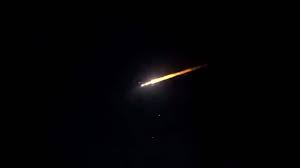
The Australian Space Agency said that a mysterious fireball seen in Melbourne on Monday night is likely to be the remains of a Russian missile.
Residents heard a loud explosion followed by an aftershock that resembled an earthquake before the object flew across the sky.
Meteor shower over Melbourne or space debris?
Geoscience Australia has identified seismic signals usually related to earthquakes northwest of the city.
Residents needed clarification about whether the stunning light show was space debris or a meteor shower.
One resident posted: “Amazing sight tonight in the sky above SE Melbourne #meteor#sonicboom#SpaceX Falcon 9 debris?” One resident posted the following.
A second account from Exploring Melbourne posted this: “What a spectacular sight over Melbourne.” It was a spectacular sight to see.
The Australian Space Agency investigates
The Australian Space Agency confirmed on Tuesday that the light flashes seen likely came from the remains of a Russian Soyuz-2 reentering Earth’s atmosphere.
The agency reported that the rocket launched from the Plesetsk Cosmodrome, Russia, earlier in the evening.
According to Russian authorities, the launch launched a new global satellite navigation.
The remnants of the rocket would safely reenter the atmosphere and land in the ocean just off the coast of Tasmania’s southeast.
Space debris is often mistaken for meteors.
Michael Brown, an associate professor at Monash University’s School of Physics and Astronomy, said space debris is often confused with meteors. He noted that space junk reentry into Earth’s atmosphere is usually shorter since they hit at speeds exceeding ten kilometers per second.
He said the rocket experienced massive forces as it entered the air, which heated it and caused it to break up, creating a spectacular show.
Brown stated that a Soyuz missile had been reentered above Melbourne in 2014. Some of its fragments were later discovered in rural NSW.
Alan Duffy, an astronomer, said that space junk could be easily identified by the color it emits.
It was significant because it moved very slowly – indicating it was dense.
He said that as the orange pieces broke, it was evident that the material used was steel or iron.
It was one of the most spectacular reentries that I have ever seen.