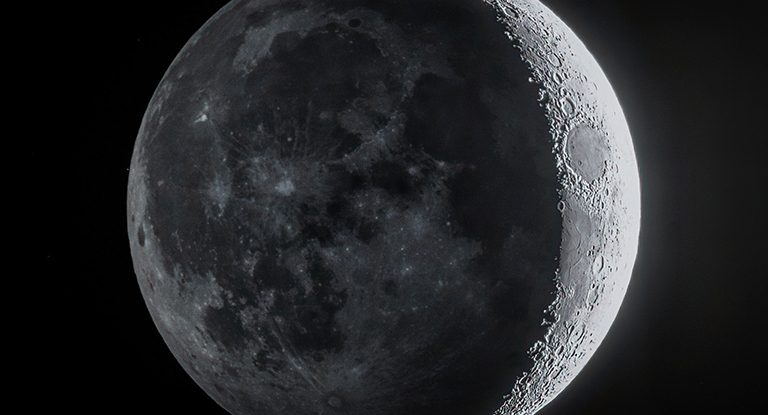
We know that there is one on the Moon, but it needs to be clarified where it comes from. New research suggests that electron waves, which are arriving from Earth and the Sun indirectly, contribute to the formation of frozen water on the surface of the Moon.
The electrons are hitting the Moon when it passes through Earth’s Magnetotail.
The magnetotail contains a plasma sheet that is made of electrons and ions with high charges, which are pulled from Earth’s atmosphere by solar wind radiation.
Scientists have looked at the role that the magnetotail and the larger magnetosphere could play in the formation of lunar water. The magnetosphere forms when Earth’s magnetic field repels solar wind. It leaves behind a variety of effects.
Shuai Li, a planetary scientist at the University of Hawai’i in Manoa, says that this is a great opportunity to study the processes of the formation of the surface water on the Moon.
The lunar surface is bombarded by solar wind when the Moon is outside the magnetotail. In the magnetotail, there are almost zero solar wind protons, and water formation is expected to be near zero.”
Remote analysis indicates that this is not the case. Previous studies suggested that hydrogen ions generated by solar winds were responsible for water formation on the Moon. However, this water still forms when the surface of the Moon is shielded from solar wind within the magnetotail.
Researchers believe that other forces, specifically electrons, are at work. High-energy electrons could react with the lunar surface, releasing trapped hydrogen, which can then be converted to water.
Li says that there could be other formation processes in the magnetotail or even new sources of freshwater not directly related to the implantation of solar wind protons. “In particular the radiation from high-energy electrons has similar effects to solar wind protons.”
It is one of the being investigated by scientists to determine the origins of the Moon’s first water.
Scientists are fascinated by the water source on the Moon for many reasons: it teaches them more about the Moon’s past and is also crucial in figuring out how we can live on the surface of the Moon.
Li says that his findings and his previous ones of rusty poles on the Moon indicate that Earth and its Moon are closely connected in many ways that need to be recognized.