Nature has experimented with wild solutions to life’s problems over a long period, which is valid for vision.
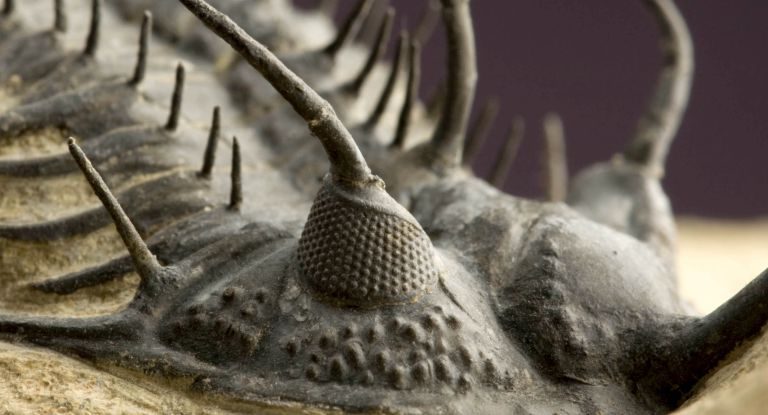
The earliest complex eyes may have used a material not present in modern organisms to focus light. These eyes came from an extinct group called Trilobites. They were made out of hard crystal – calcite, a mineral.
Trilobites were extinct about 250 million years ago but had been around for 300 million years before that. Trilobites have various body plans preserved in fossils, indicating that these 300 million years were successful. Because their stone eyes were so unusual, they were preserved beautifully in the fossils they left behind.
From this, trilobites had complex eyes similar to insects. They were composed of clusters called ommatidia, each with their photoreceptors. Fossilized lenses are a crystalline substance made of calcite.
The calcite crystals are transparent, and light can pass through them to be focused where photoreceptors can detect it. It was likely involved in insect vision. Trilobites were not likely to see with high spatial resolution, but they would have been sensitive to movement.
These trilobite eye types were of three different kinds. The oldest type is known as Holochroal. In this case, small ommatidia are covered by a corneal membrane with adjacent lenses in contact.
Abathochroal eyes are only found in the family Eodiscidae. The tiny lenses have a thin, transparent cornea.
The schizochroal eyes are only found in the Phacopina. Each lens has a cornea and is more extensive. Scientists believe that they were highly specialized.
Scientists believe the holochroal eyes resemble the apposition eye found in insects and crustaceans. They also work similarly. The holochroal look is the most similar to the modern.
Calcite is more challenging to work with. Calcite is one of nature’s strongest birefringences. It has two refractive indexes. Light will be divided twice when it travels through the calcite. The two rays traveling at different speeds produce a double image.
This is unlikely to be a concern for small ommatidia, as seen in a holochroal retina; the deviation of the rays is smaller than the light-sensing organ.
Birefringence is more problematic for the schizochroal eye. The larger ommatidia cannot change the focus of the crystal to reduce the effect. Scientists have discovered that the schizochroal eye has what’s known as a dual-lens structure.
This means that the lens comprises two layers with different refractive indices, which can correct for birefringence. It’s almost as if trilobites came equipped with built-in glasses. In the 17th century, Rene Descartes, Christian Huygens, and other mathematicians independently invented lenses of this kind, not knowing that trilobites were the first to do so.
A different Structure suggests that we don’t understand the schizochroal eyes.
A study revealed that schizochroal eye complexes are more complex than previously thought. This brings us closer. Each lens covered a compound eye, creating a “hyper-eye.”
We could have been entirely wrong about trilobite sight. According to a 2019 study, the calcitic crystalline corneas could have been an artifact of preservation. This suggests that the crystal eyes may not be as unique as many believe.
Scientists studying trilobite eyes have a different way of looking at the sight.