A physicist’s analysis of colliding proton collisions is solving the mystery as to how protons acquire their intrinsic property, known as spin 1.
Protons, along with neutrons, are contained within the nucleus of an atom. They have spin, an internal property like many subatomic particles.
Since the 1960s, physicists have known that protons consist of elementary particles known as quarks and gluons. Each particle has its spin.
Yasuyuki Akiba, a particle physicist with the RIKEN Brookhaven Research Center and spokesperson for the PHENIX Experiment at the Relativistic Heavy Ion Collider in Brookhaven National Laboratory, New York, USA, says: “Initially, it was assumed that the proton’s spin came directly from its quarks.” In the 1980s, however, experiments revealed that only 30% of the spin of the proton was due to quarks.
The fundamental question then was: Where does the remainder of the proton spin come from? Says Akiba. The physicists began a search to find the source of 70% of the proton spin that was missing.
The gluons are massless particles that hold the quarks together within a proton. Around seven years back, teams working on PHENIX, as well as a second RHIC-based experiment called STAR, determined that the spins of gluons contributed to the reels of the proton. They could not, however, determine whether the spins of gluons are aligned with the spin direction of the proton that contains them.
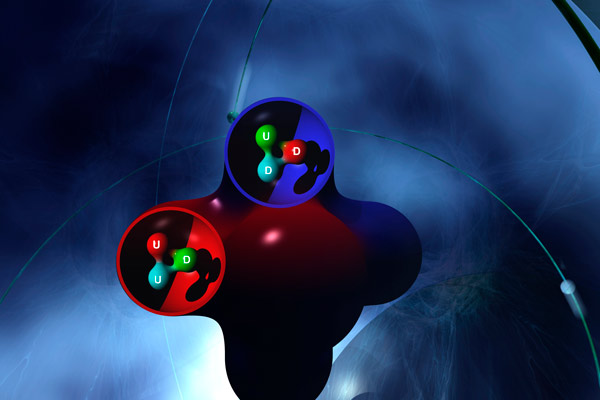
Figure 1: Internal structure of protons (left) within a lithium atom. The proton is composed of three quarks, but its spin doesn’t match the sum of spins. (c) MIKE & CAROL WERNER/SCIENCE PICTURE LIBRARY
This is where the new analysis comes into play. A gluon, which is a particle or light, can be converted into a photon during collisions between two protons. Direct photons are the photons that result from this process. It is a very rare process, so the PHENIX photon-measuring device needed 25,000 detectors in order to detect it. Akiba says, “It is like the compound eyes of insects.”
The physicists looked for direct photons produced in two types of collisions of protons. One class was where the protons colliding had spins aligned, and the other was where they had reels facing in opposite directions.
The researchers observed a slight increase in direct photon production when the proton spins pointed in opposite directions. It is clear that the gluon spins are pointing in the same direction as the proton spin and can, therefore, contribute to its spin.
But a puzzle remains. Calculations show that the gluon spins only add 20-30% of the proton spin. So, there’s still something missing. This could be due to the motion of gluons or quarks.
Akiba says that a new accelerator called the Electron-Ion Collider is being built at Brookhaven. This could be the answer.