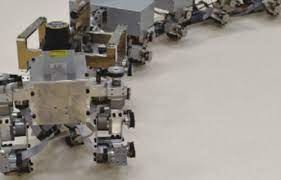
OSAKA (Japan) — You’ve seen robot dogs before, but now Japanese scientists have created a robot centipede that can change its movement from a straight path to a curved one instantly. Researchers at Osaka University’s Department of Mechanical Science and Bioengineering say that this new type of walking robot uses dynamic stability to move. It could be helpful in various tasks, from space exploration to search-and-rescue operations.
By changing the couplings’ flexibility, the robot can turn without the need for complicated computational control systems. In nature, animals have evolved a locomotion system that allows them to move in various environments. In the past, engineers have found that robots equipped with legs can be fragile. Even if one leg fails due to repeated stresses, it will severely restrict the ability of such robots to function. Controlling a robot’s many joints to traverse complex environments requires a lot of computer power. Design improvements could be beneficial when building semi-autonomous or autonomous robots intended to enter dangerous environments or act as exploration vehicles.
The research team at Osaka University has developed a biomimetic robot called a “myriapod,” which takes advantage of the natural instability to convert straight walking into curved motion. Researchers describe the robot in a recent study. It consists of six segments with two legs at each part. The flexibility of the couplings is changed by motors using an adjustable screw.
The study’s authors showed that increased flexibility in the joints caused a situation known as a ” bifurcation,” where straight walking becomes unstable. The robot will instead walk in a curved path (either to the left or right). Engineers would avoid instabilities in any other scenario. In this scenario, however, the controlled use of these forces allows efficient maneuverability.
In a release, Shinya Aoi, co-author of the study and co-author, says that certain extremely agile insects inspired them. They can control the dynamic instabilities in their movement to cause quick movement changes.
This approach, which does not directly steer the body’s axis but instead controls it through flexibility, can reduce both the computational complexity and the energy requirements. Researchers tested the robot’s navigation ability and found it could take curved paths toward targets.
The study’s co-author, Mau Adachi, concludes that “we can imagine applications in many scenarios, including search and rescue or working in hazardous environments.