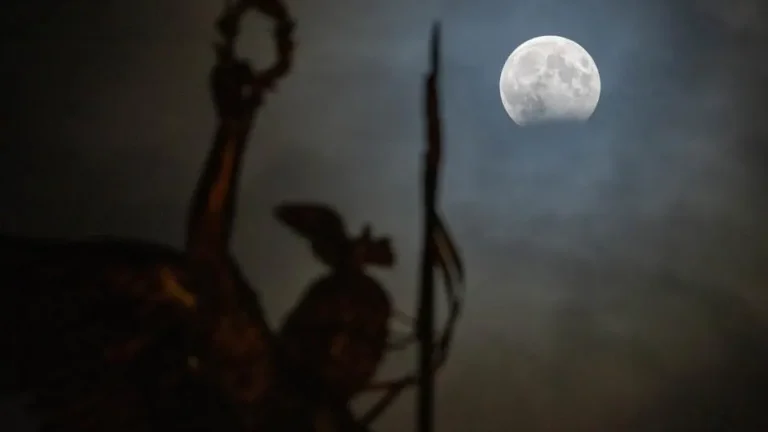
The October full moon, also known as the “Hunter’s Moon,” rose on Saturday and, for some people, was partially eclipsed.
The partial lunar eclipse can be seen best in Europe, Africa, and Asia.
The full Moon was visible at the moonrise near 3:35 pm EST on Saturday, October 28. Every 29.5 days, the Moon is full. In reality, it takes only 27.3 days for one orbit of the Earth to be completed. During that time, Earth travels slightly farther around the Sun on its orbital path. Therefore, the distance between phases of the Moon is longer.
Lunar eclipses can only happen at full Moon. The Moon enters Earth’s shade, and it can only occur when the Earth is on the other side of the Sun. On Saturday, there was a partial eclipse of the Moon. Earth’s shadow in space is divided into two parts: the darker inner umbra of Earth and its lighter outer penumbra. During the eclipse, the majority of the Moon was in the penumbra. At peak eclipse, only 6% of the lunar surface was in the umbra. This left the Moon looking like it had a small hole cut out.
Jupiter was visible just 3o beneath the full Moon as it rose into the sky. The “Hunter’s Moon,” like all full moons, was visible throughout the night. It grew in the east just before sunset and set in the west shortly after sunrise. The October full moon, also known as “Hunter’s Moon,” is so named because its brightness all night long helped hunters hunt game during the crucial weeks before the cold weather set in.
The only way a total lunar eclipse, also known as a “Blood Moon,” can occur is when the entire Moon enters Earth’s umbra. This will happen again on March 13/14, 2025. The total lunar eclipses usually occur in threes in a lunar year (354 days). Other dates in this triumvirate are September 7/8, 2020, and March 2/3, 2026.
It may be logical to have a lunar eclipse every month. Every full Moon must be opposite the Sun in order to be illuminated. The Moon’s orbital plane is tilted by about 5% in relation to Earth. This is enough to prevent it from being exactly in the right position to pass through Earth’s shade.
Solar eclipses, which are caused when the Moon moves in front of the Sun from our perspective, are also relatively rare due to the tilted moon orbit. It’s not a coincidence that the partial lunar eclipse happened two weeks after a solar annular eclipse visible in the Americas. The Moon may have an orbit that is tilted in relation to Earth, but its orbital path crosses Earth twice every month. Solar or lunar eclipses must happen when this occurs at the time of a new or full Moon. A second eclipse usually happens two weeks later.