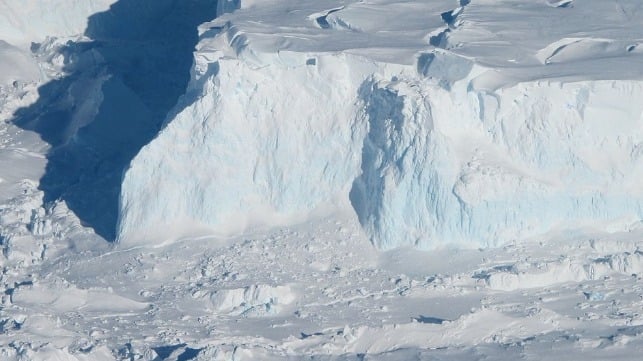
Our new research indicates that the rate of melting of the West Antarctic Ice Sheet by the Southern Ocean will accelerate rapidly during this Century regardless of the amount of emissions reductions in the coming decades. The melting of the West Antarctic ice sheet is likely to cause sea level rises around the globe.
The Antarctic ice sheet, which is the largest land-based volume of ice in the world, is made up of interconnected glaciers that are covered with snowfall all year round. The floating edges of the ice sheet are coastal ice shelves, which stabilize the glaciers that lie behind them. The ocean melts these ice shelves from below. If melting increases and the ice shelf becomes thinner, then the rate at which the glaciers release fresh water to the ocean will also increase.
This process has been ongoing in West Antarctica for many decades, especially in the Amundsen Sea. The ice shelves are shrinking, the glaciers are moving faster to the ocean, and the ice sheets are getting thinner. Modeling suggests that climate change may have caused the ocean temperatures to rise in this area despite limited measurements.
The Amundsen Sea was chosen as the model because it is the most vulnerable part of the ice sheet. A regional ocean model was used to determine how the melting of the ice shelf will affect this region between now and 2100. We used a regional ocean model to find out how much melting we can prevent by reducing emissions and slowing climate change. And how much melting is unavoidable no matter what.
Rapid Change is Locked in
The UK’s supercomputer, ARCHER2, was used to run a number of simulations for the 21st Century. These included a total of over 4,000 years of ocean warming and melting ice shelves.
We looked at different scenarios for burning fossil fuels, from the best-case method, where global warming was limited to 1.5degC, as per the Paris Agreement, up to the worst-case scenario, which is the uncontrolled use of coal, oil, and gas. We also looked at the impact of natural variations of the climate, such as El Nino.
The results are alarming. All simulations show a rapid rise in ocean warming and melting of the ice shelf over the next Century. Even in the best-case scenario, where warming stops at 1.5degC – something many experts consider ambitious – the rate of melting and warming will increase by three times.
There is also little or no difference in the scenarios until 2045. The ocean warming and melting of the ice shelf in the 1.5degC scenarios are statistically identical to a mid-range situation, which is closer to what existing pledges for reducing fossil fuel usage over the next decades would produce.
Experts believe that this level of future fossil fuel combustion is unrealistic.
These results indicate that, regardless of the international policies regarding fossil fuels, we will continue to warm up the oceans in the Amundsen Sea at a rapid rate until 2100.
Ocean currents are driving warm water out of the deep ocean and towards the shallower shelves of ice along the coast. Satellite measurements of ice shelf shrinkage have been attributed to this process by other studies.
How high will sea levels rise?
The melting of ice shelves is a major factor in sea level rise, but it’s not the only one. Our model did not include the rate at which snow accumulates on the Antarctic ice sheet or the flow of Antarctic ice glaciers.
We have good reason to believe, however, that the sea level will rise faster if the ice shelves in this area melt more quickly.
West Antarctica’s ice sheet contributes to sea level rise in the world and loses about 80 billion tonnes a year. There is enough ice in the West Antarctic ice sheet to raise sea levels by up to five meters, but we do not know how fast it will melt. This question is being answered by colleagues all over the world.
Courage, hope and
Climate change has consequences that cannot be avoided, no matter how low fossil fuel consumption falls. One of these consequences may be the melting of West Antarctica by 2100.
How can you convey bad news? Conventional wisdom says that you should give people hope by saying that a disaster is behind one door but that we can avoid it by choosing a different one. What happens when science says that all entries will lead to disaster?
Kate Marvel, an atmospheric scientist, stated that “courage is the determination to succeed without the guarantee of a happy outcome.” Courage, in this case, means focusing on the long term.
Even if the majority of people who read this article will no longer exist, the future won’t end in 2100. Our simulations show that the melting of the ice shelf will plateau at the end of this Century. This suggests that future changes in the 22nd and beyond centuries may be avoidable. Many coastal cities could be saved if sea level rise is reduced or slowed down after 2100.
Courage is accepting that we must adapt. We can protect coastal communities when it is possible or rebuild them if it’s not. We can plan by predicting the future rise of sea levels.