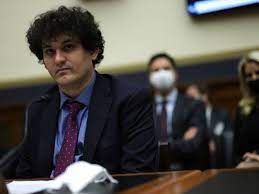
Sam Bankman-Fried was found guilty of his role in the collapse of the Crypto Exchange FTX.
After about four and half hours of deliberation and 15 days of testimony, the jury returned a verdict, finding him guilty of seven counts of fraud.
The verdict was read, and Bankman-Fried appeared to be sunk as he listened.
He stood with his head bowed, shaking, as his attorney spoke to him.
His parents were standing a few feet away.
Bankman-Fried smiled back at his parents as he was led out of the room.
Joe Bankman put his arm around the shoulders of his wife. Barbara Fried began to cry as their son left the house.
The date of sentencing will be March 28, 2024.
Bankman-Fried has been found guilty of stealing millions of dollars from the accounts of customers of FTX, his former high-flying cryptocurrency exchange.
He was found guilty as well of defrauding the lenders of FTX’s sister firm, Alameda Research. This hedge fund held FTX customers’ funds in a banking account.
During the trial, Bankman-Fried stated that he discovered in 2020 that Alameda was holding FTX funds, but he didn’t take any action to protect them.
No one was fired when he discovered, in 2022, that Alameda owed FTX $US8 billion (12 billion dollars)
Bankman-Fried also faces charges of defrauding investors at FTX and money laundering.
The verdict ends a year-long saga in which Bankman-Fried, 31, went from being a billionaire in a Bahamas luxury apartment to being a defendant in the largest white-collar criminal case since Bernie Madoff’s Ponzi scheme collapsed in 2009.
FTX used to be one of the most respected names in crypto.
Investors and regulators have closely followed the trial for any signs that a larger crackdown could be coming on the unregulated crypto market.
The verdict was delivered a year after FTX went into a death spiral, which fueled a panic within the trillion-dollar crypto sector and exposed an estimated 1,000,000 customers to potential losses.
Before its collapse, this exchange had attracted millions and a group of A-list supporters, including Tom Brady and Gisele.
FTX was founded by Bankman Fried in 2019. It billed itself as a simple and safe way to trade cryptocurrencies – digital assets whose value is based largely upon a collective expectation for their future use, which is still murky.
FTX, a crypto-portal, became extremely popular in the early 2020s when interest rates were at zero, and there were millions of homebound amateur investors.
By 2022, FTX had Super Bowl advertisements and its name plastered on the Miami Heat arena.
FTX filed for bankruptcy on November 11, 2022, after a panicked run by customers sparked off by a document leaked that suggested irregular financial transactions between FTX and another company owned by Bankman-Fried.
Unlike bank customers, FTX investors did not have a federal insurance fund that would compensate them if their cash ran out.
Despite FTX’s public assurances it did not invest or move customers’ deposits in any manner, Bankman-Fried’s other firm secretly siphoned deposits to repay their lenders, underwrite executive luxury lifestyles, bet on crypto markets, and funnel millions into US political campaigns.
The other company was Alameda Research. It is a crypto trading firm similar to a hedge fund that Bankman-Fried founded in 2017.
What Alameda did
According to Wang’s testimony, almost as soon as FTX launched in 2019, Bankman-Fried instructed co-founder Gary Wang, and Chief Technology Officer Nishad Singh, to modify the platform’s software to give Alameda certain “special privileges” other customers did not have.
As part of a plea agreement with the government, both Wang and Singh pleaded guilty to financial crimes.
Wang said that these privileges included an almost unlimited credit line for Alameda, which its executives could use at any time.
Alameda’s main trading account also received an “allow negative” flag. This meant that it could incur a positive balance without repercussion – a privilege no other FTX customers were granted, Wang testified.
Star witness: Ex-girlfriend
Over four weeks, Bankman Fried watched as a number of people whom he had once considered to be his closest confidantes were called to testify against him.
Caroline Ellison, 28, was his trusted business advisor and ex-girlfriend from MIT and math camp.
Ellison, the prosecutor who testified over three days for Bankman-Fried, provided the most damning evidence.
Ellison, who was both CEO of Alameda as well as Bankman-Fried’s romantic partner for two years, was in a unique position to comment on the inner workings of the Alameda executives and FTX executives. Many of them lived in a luxury apartment worth $US30,000,000 ($46,000,000) in the Bahamas.
Ellison’s emotional testimony at times provided a narrative in which almost every decision made at Alameda or FTX was determined by Bankman-Fried, who founded both companies and owned the majority of them.
Ellison’s response to questions about who ordered her to commit various criminal acts or other crimes was often a variation of the phrase “Sam did.”
Hail Mary of SBF
Bankman-Fried was immediately challenged by a group of high-level witnesses who were all against him.
His defense lawyer appeared to stumble during the trial when cross-examining these witnesses.
In criminal cases, lawyers advise clients not to testify as this could expose them to potentially damaging cross-examination by prosecutors.
However, several legal experts have said that Bankman Fried’s case is an exception.
He was left with no one to help him fight the business partners that had turned against him.
Bankman-Fried’s career was built on high-stakes risks like taking the stand.
Howard Fischer, the former SEC lawyer and partner of Moses Singer, stated that Bankman-Fried had an excessive appetite for and tolerance for risks.
“Testifying takes a lot of effort,” Fischer explained, that it isn’t just about getting the facts right but also learning how to answer questions and deal with the stress of cross-examination.
Before taking the witness stand, it is best to practice for months in front of mock juries.
Bankman-Fried’s preparation for trial was significantly complicated after Judge Lewis Kaplan revoked bail in August after prosecutors claimed the defendant leaked information about Ellison to the New York Times.
After other incidents of alleged witness interference, that was the final straw for Kaplan. He remanded Bankman Fried to a federal prison in Brooklyn, New York, where his access was limited to lawyers.