The patterns of quasicrystals are not repeated, unlike ordinary crystals. Quasicrystals made from atoms may have extraordinary properties. For example, they can absorb heat and light in different ways, exhibit unusual electronic properties like conducting electricity without resistance, or their surfaces might be very hard or slippery.
The challenge is to get the particles to assemble into useful structures. By building this first DNA-assembled quasicrystal, the team has entered a new frontier in nanomaterial design. The existence of quasicrystals was a mystery for decades, and their discovery was appropriately awarded a Nobel Prize,” said Chad Mirkin the George B. Rathmann professor of Chemistry at Northwestern University, who is also the co-corresponding author. The existence of quasicrystals has been a mystery for decades, and their discovery was appropriately awarded with a Nobel Prize,” said Chad Mirkin, the George B. Rathmann Professor of Chemistry at Northwestern University and co-corresponding author of the study.
Mirkin’s team is well-known for using DNA to engineer colloidal crystals composed of nanoparticles. The group of Luis Liz Marzan at the Spanish Center for Cooperative Research in Biomaterials could create nanoparticles which, under certain conditions, might form quasicrystals. The team concentrated on bipyramidal forms, which are two pyramids glued together at the base. Liz-Marzan’s group experimented with different shapes, including squashing or stretching them. Wenjie Zhou, a doctoral student in chemistry from Northwestern University at the time, and Haixin Lin used DNA strands that were encoded so they could recognize each other to program the particles into an assembled quasicrystal.
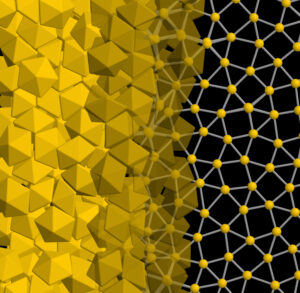
In an independent group, Sharon Glotzer of the Anthony C. Lembke chair of Chemical Engineering, U-M had simulated bipyramids of different numbers of sides. Yein Lim, a doctoral student in chemical engineering, and Sangmin Lee found that pentagonal decahedra (10-sided bipyramids) would form a semicrystal when given the right conditions and relative dimensions.
Glotzer’s team predicted in 2009 the first layered quasicrystal nanoparticle, but not using bipyramids, but tetrahedra, single pyramids with four triangle-shaped sides, like a D4 dice. She says the decahedron is a smart choice because five tetrahedra are almost a type of decahedron.
In our original simulation of a quasicrystal, the tetrahedra were arranged in decahedral with very small gaps. It was logical that the DNA would fill in those gaps, and decahedra could also form quasicrystals,” said Glotzer.
The three research groups combined theory and experiment to turn the decahedrons into a semicrystal. This was confirmed through electron microscope imaging done at Northwestern University and X-ray Scattering at Argonne National Laboratory.
Liz-Marzan is the co-corresponding author. She said, “Through our successful engineering of colloidal pseudocrystals, we have achieved an important milestone in the world of nanoscience.” Our work sheds light not only on the creation and design of intricate nanoscale structures but also opens up a whole world of possibilities for innovative nanotechnology and advanced materials.
This structure is a rosette array in concentric circles. The 10-sided shapes create a 12-fold symmetry in 2D stacks that are stacked periodically. The stacked system is also found in quasicrystals that are made of tetrahedra. It’s called an axial pseudocrystal. The tiling patterns of the new layers are not identical to those in most axial pseudocrystals. The tiles are arranged randomly, with a large percentage of them being different. This small amount of disorder increases stability.
The research was funded by the U.S. Air Force Office of Scientific Research (USAFR), the U.S. Department of Energy (DOE), the Spanish Ministry of Science and Innovation, and the Maria de Maeztu Units of Excellence Program of the Spanish State Research Agency. The project also relied on resources from the Extreme Science and Engineering Discovery Environment (NUANCE) at Northwestern University and computing resources at U-M.