Scientists observed for the very first time faint ripples that were caused by black holes gently stretching and squeezing the entire Universe.
The scientists reported that they could “hear” low-frequency gravitational waves – changes to the Universe’s fabric caused by large objects colliding and moving in space.
The results were published in The Astrophysical Journal Letters by the research collaboration NANOGrav.
Scientists observed for the very first time faint ripples that were caused by black holes gently stretching and squeezing the entire Universe.
The scientists reported that they could “hear” low-frequency gravitational waves – a change in the fabric created by large objects colliding and moving in space.
The results were published in The Astrophysical Journal Letters by the research collaboration NANOGrav.
Scientists have searched for waves with lower frequencies in the most recent research. These slow ripples may take many years to cycle or even several decades. They are probably caused by some of the most significant objects in the Universe: black holes that are billions of times the sun’s mass.
As galaxies collide and merge, they are constantly interacting. Scientists believe that the black holes in the center of the galaxies are also colliding and merging.
As they rotate in pairs, these black holes emit gravitational waves.
Marka stated that “supermassive black holes binaries slowly and calmly circling each other are the tenors of the cosmic orchestra.”
No instrument on Earth was able to capture the ripples of these giants. Michael Lam, a researcher at the SETI Institute and NANOGrav, said, “we needed to build a device roughly the same size as the galaxy.”
NANOGrav has used telescopes in North America and Europe to look for waves. Other teams around the globe have published research on gravitational waves, including those in Europe, India, and China.
Scientists pointed telescopes to dead stars known as pulsars that send out flashes and radio waves while they spin in space, like lighthouses.
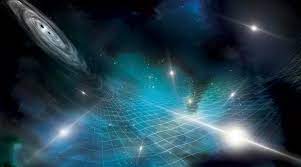
Scientists know when these bursts will arrive on Earth. “Like a perfectly regular timepiece ticking away in space,” said Sarah Vigeland of NANOGrav, an astrophysicist from the University of Wisconsin – Milwaukee. As gravitational wave warps the fabric of spacetime, they change the distance between Earth’s pulsars and the pulsars themselves, causing the beat to be thrown off.
Scientists could detect gravitational waves by analyzing tiny differences in the ticking rates of different pulsars. Some pulses came slightly earlier and others later.
The NANOGrav Team monitored 68 pulsars using the Green Bank Telescope (West Virginia), the Arecibo Telescope (Puerto Rico), and the Very Large Array (New Mexico). Other teams have found evidence of similar nature from dozens more pulsars monitored by telescopes worldwide.
Marc Kamionkowski is an astrophysicist from Johns Hopkins University who wasn’t involved in the research.
It’s more like a constant hum, which is everywhere. For example, if you are standing in a crowd, you will hear everyone talking but not anything specific, Kamionkowski explained.
Mingarelli stated that the background noise found was “louder than expected” by some scientists. This could indicate that more significant or more black hole mergers are taking place in space than previously thought or that other sources of gravitational waves could be challenging our understanding of the cosmos.
Researchers hope studying gravitational waves this way will help us learn more about our most significant objects. Marka says it could lead to a new field of “cosmic archaeology,” which can trace the history and merging of galaxies and black holes around us.