The interaction between machines and people is crucial to the development and implementation of new metaverse technologies, which aim to enhance the human experience via cloud computing and Extended Reality (XR). Wearable sensor technology based on graphene, a carbon-based two-dimensional material, is paving the path for a new era in seamless human-machine interface (HMI).
Tian-Ling Ren, a material scientist from Tsinghua University Beijing in China, led a team of material scientists to describe the current state of graphene-based HMI sensor technologies. The goal was to advance the research in this field. HMI can benefit from advanced sensor technologies, which are lightweight, flexible, and can be worn constantly. They are also ideal for immersive virtual worlds of the metaverse as well as wearable healthcare technologies. The current research aims to create sensors that can interface with nearly every part of your body, including the eyes, brain, and mouth. An interface machine can use the measurements taken to categorize bodily information.
The team published its review in Future Carbon on 13 August 2023.
In this review, our team presents an overview of the efforts of its research team to develop graphene sensors for human-machine interaction. The sensors are designed to be used on different parts of the body. They are described with an emphasis on their design, manufacturing process, and performance characteristics. We also explore future potential developments for graphene sensors, such as multi-modality and improved comfort. Dr. Ren holds the Yangtze River scholar professorship from the Chinese Ministry of Education and is vice director of Tsinghua University’s Center for Environmental and Health Sensing Technology.
Graphene is a single layer made of carbon atoms arranged in a hexagonal grid. Graphene’s unique properties, such as its impressive conductivity, low reactivity to chemicals, flexibility, and lightweightness, make it an ideal material for the development of human-machine interaction sensors.
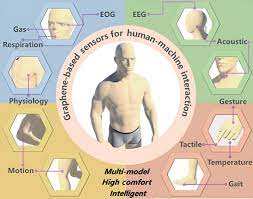
The team of researchers outlines the progress that has been made with graphene-based sensors designed to measure different signals from the human body. Many parts of the body, from head to foot, have the potential to become human-machine interfacing devices. Tian-Ling Ren stated that the brain, eyes, ears, and nose, as well as skin, joints, and feet, can be used to interface with HMIs. These interfaces are based on electroencephalograms (EEG), Electromyography (EMG), Electrooculogram (EOG), light, breathing and voice, temperature, motion, gait, and other physiological data.
In a previous study, Ren’s team demonstrated graphene sound production. Ren’s group showed graphene sound generation in an earlier study. Tian Lin Ren stated, “With machine learning, this can achieve speech and emotion recognition, content processing, etc., making it perfect for intelligent robot communication.”
The challenge of developing graphene sensors is to achieve a large measurement range that can detect dynamic senses such as touch. In order to address this problem, a graphene-based pressure sensor with a large sensitivity range has been developed by using loosely stacked Laser-Scribed Graphene (LSG) films that increase density as pressure increases. This increased density in the film causes a change to be measured in resistance, with a large enough range to achieve high sensitivities.
The team of researchers expects that the review will spur the development of new graphene sensors to improve healthcare data collection and to provide more natural HMIs. In the next few years, graphene-based HMI sensors are expected to be more versatile and practical. Tian-Ling Ren said that the human and the machine can interact in different ways with the same signal… on the same part.