The blue-eyed La Hotte glandular frog lives deep in the forests of Haiti. It was 20 years before scientists noticed it. The genus includes the coqui frog, a Puerto Rican cultural icon. A fossil study has revealed that the genus Eleutherodactylus frogs are the oldest Caribbean vertebrates found in Florida. The frogs also reached North America earlier than thought.
Scientists knew that some North American Frogs originated in the Caribbean but lacked fossils to show when and how these movements had taken place. Maria Vallejo Pareja, a graduate of the University of Florida, used fossil collections that had not been studied to make the connection.
Vallejo Pareja, the first author, said, “There was an information gap, but it was right under our noses all along.” “We had fossils that were collected in the 1970s and 1990s. “We just hadn’t worked with them.”
Scientists do not have a complete record of frog evolution. After the mass extinction of the Cretaceous and Paleogene 66 million years ago, data analyses reveal that the frog family underwent rapid divergence. The frog species continued to evolve for several million years. The first time they appear in Florida’s fossil records is during the Oligocene Epoche, which lasted between 34 and 23 million years ago. These records are scattered.
Frog paleontology is a small field, and the frogs themselves are not well studied.
Researchers at the Florida Museum faced a difficult challenge when they discovered a large number of frog fossils in Florida dating back to the Oligocene. These included the Brooksville 1 and Live Oak SB-1A sites. The fossils collected in the 1970s and 1990s didn’t have a high priority for research, so they were stored, where they remained unstudied until Vallejo Pareja’s work.
Vallejo Pareja compared the fossils collected in Florida to existing collections of frog specimens. These included the Florida Museum samples of the La Hotte Glande frog. She discovered that the majority of fossils collected belong to Eleutherodactylus – also known as rain frogs and robbers frogs.
Rain frogs are known to move around. The Caribbean is where they originated from an ancestor who dispersed out of South America 47 million years ago during the Eocene Epoch. The ancestral population quickly diversified on the islands through a process known as adaptive radiation. Charles Darwin’s observations of the finches in the Galapagos Islands are an example. One migrant species rapidly evolved into 13 different species by filling new feeding niches.
Rain frogs can be found today in parts of Central America and the Caribbean. The oldest fossil known from the genus is the coqui, which has lived in Caribbean forests for at least 29,000,000 years. It was accidentally imported into Florida, Hawaii, and other states in the 1970s and 1980s on nursery plants.
Scientists believe DNA analysis has led them to believe Caribbean frogs of the Eleutherodactylus genus first arrived in Central America in the middle Miocene Epoch (16 to 11 million ago) before spreading to North America. This study shows that rain frogs lived in Florida as early as the Oligocene Epoch, several millions of years before they were recorded to have dispersed into Central America.
It’s unclear how the frogs got to Florida. It seems likely that they were carried over the water on flotsam and other buoyant debris, but the Florida peninsula at the time was still underwater. It is estimated that the frogs’ journey would have been more dangerous and longer than it is today due to increased distances between land.
Vallejo Pareja believes that this hypothesis needs to be tested with more fossils found in Central America. Frogs are highly mobile and small, making it easy to underestimate their presence in an area.
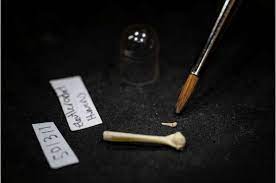
Vallejo Pareja stated that “these fossils are millimeters large.” The smallest fossil was only 16 millimeters long from the snout to the rear, which is smaller than an American penny. It was an amazing experience to be able to handle them without damaging or losing them. “I mean this literally because if I sit at the microscope and my fossil is there, if I sneeze, or breathe too much, it will be gone.”
These findings indicate that while rain frogs have spread throughout North and Central America, Florida was their first home. They also had some interesting company. The sites of Live Oak SB-1A, Brooksville 2, and the abundance of rain frog fossils included other extinct animals such as bear dogs and bone-crushing dogs, a carnivore similar to a weasel, squirrels, and beavers.
Eleutherodactylus, the first known Caribbean vertebrate to spread into Florida, is by far one of the oldest accounts. There is fossil evidence that rodents, salamanders, and other animals made the trip from North America back to the Caribbean in the Oligocene or Miocene. However, there are few records of movement from Florida to the islands. The Miocene epoch saw the crossing of Caribbean toads as well as snakes, lizards, and other reptiles. However, these records are not conclusive, and further research is needed.
Vallejo Pareja expressed her admiration for all the hard work already done and hoped that the data and methodology created by the paper would help to further frog research. She said that we need to do more. She made 3D digital models of the fossils used in the study to provide more information to interested people. She noted that paleontologists may find a frog’s bone without realizing what it is. They now have a new reference point.
Vallejo Pareja hopes to continue using the methods developed during this study in the future better to understand the adaptation of frogs to environmental change. Frogs are very sensitive to temperature and precipitation changes, even though they have survived a few major extinction events.
What happened to the frogs at a glacial maximum? She asked. She asked. Did they increase or decrease in diversity? Did they survive or not? “It would be nice to look back in time and see what frogs did.”