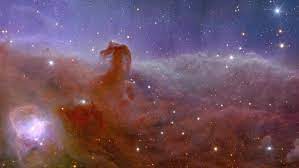
A swirling landscape dotted with dazzling lights is dominated by a gas mane that emerges from an intergalactic dust cloud. The horse looks out from the turbulent river at a sea of stars in the distance.
The Horsehead Nebula is a beautiful region in space located within the constellation Orion. It is located approximately 1,375 light years from Earth.
The Euclid telescope of the European Space Agency captured it in breathtaking detail, revealing an area of space that was rich in star formation activity.
Euclid took only an hour to take the picture.
Euclid may not have received as much attention as NASA’s James Webb Space Telescope, the golden-mirrored baby of next-generation telescopes, or its predecessor Hubble, yet it is just as impressive.
Simon Driver, a radio astronomer and astronomer from the University of Western Australia’s International Centre for Radio Astronomy Research, said that in a few days, Euclid would cover more sky area than Hubble had covered over its lifetime.
The 1 billion Euro ($ 1.66 billion) telescope has produced stunning images in its first color release overnight. They are as good as any images that its sister space telescopes could ever have sent back to Earth.
What is Euclid?
Euclid was named after Greek mathematician Euclid, who is considered to be the “father” of geometry.
The rocket was launched on 1 July aboard a SpaceX Falcon 9 launcher.
Euclid has traveled around 1,000,000 km to reach this vantage point. It will remain in a stable orbit between Earth and the Sun for the duration of its six-year journey.
Euclid’s mission will be to take high-resolution images of the entire cosmos in order to solve one of the most enduring mysteries of the universe.
Only 5% of the universe is visible to us through our telescopes.
Dark matter and dark energies, which are invisible to us, make up the other 95 percent. They are invisible to us, so we don’t even know what they look like. However, based on their interaction with gravity, they must exist.
Euclid will examine the sky using visible light and near-infrared to determine how far galaxies (and how old they are), as well as their shape.
The NISP instrument studies the near-infrared wavelengths (invisible to the human eye), while the VIS instrument sees the visible spectrum.
It’s for this reason that the European Space Agency has called it a “dark-matter detective.”
Big ball of stars
It is located approximately 7,800 light years from Earth. The image was taken after five hours of observations using VIS and NISP.
The gravity has packed hundreds of thousands of stars into the center of the picture. The number of stars increases as you move closer to the center of a spherical group.
If you look closely at the stars in JWST pictures, you’ll see that they all have a six-pointed spike. The light bounces off the sensors of the telescope.
A globular cluster contains some of the oldest stars in a galaxy. This means that they formed at the beginning of the creation of the universe.
Scientists don’t know how globular groups are formed or if they are related to the development and evolution of galaxies.
ESA claims that no other telescope is able to observe a globular cluster and distinguish stars in the same observation.
Edward Taylor, an Australian astronomer who studies galaxy evolution and formation at Swinburne University, said: “The Euclid images are stunning if you zoom in.”
The value of stepping back and taking them all in at once is mind-blowing.
Strange distant galaxies
As you move through time, more and more bizarre galaxies appear.
Euclid’s ability to detect faint galaxies at a distance of 10 billion years will allow him to look back into the distant past.
The first image drops a closer look at a strange galaxy.
It is the irregular dwarf galaxy NGC 6822. They are located about 1.6 million light-years away from Earth. This may not seem like much, but it is a fascinating object to observe.
Edwin Hubble was the first to detect it in 1925. He is an astronomer who has been credited with putting eyes on the universe.
Revealing a ‘hidden galaxy’
Caldwell 5 is located 11 million light-years away from Earth.
This galaxy might sound like Starfleet’s destination in a Star Trek movie, but it has been out of the spotlight for a long time.
Caldwell 5 (also known as the “Hidden Galaxy”) is hidden by the dusty and gaseous disc that makes up the Milky Way.
Euclid’s near-infrared cameras allow astronomers to see through the cosmic curtain to measure the light emitted by the galaxy.
Leslie Hunt is an astronomer from the National Institute for Astrophysics, Italy. He stated this in a press release by ESA.
The view is wide enough to cover the entire galaxy but can be zoomed in on to see individual stars or star clusters.
This galaxy gives us a look at what the Milky Way might appear like from across the universe.