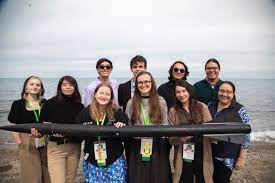
Earlier this summer, MIT’s First Nations Launch Team participated in the 2023 First Nations Launch. This was an international NASA-Artemis Student Challenge hosted by the Wisconsin Space Grant Consortium that focused on Indigenous representation in aerospace engineering and science through rocketry. This was the first year MIT had ever participated in this challenge.
In two semesters, a team of all indigenous students, including undergraduates and grads, came together to design and build a rocket measuring 8 feet tall, test it, document its performance, and then launch it. In order to meet the 2023 challenge, the team had to develop composite carbon fiber layup techniques to make an airframe as lightweight as possible without compromising structural integrity.
I didn’t think I would be joining a team of rocket builders, but I heard that an all-Indigenous team was starting. Peyton Meader is a member of the Passamaquoddy Tribe and the safety/avionics leader.
Hailey Polson is a Cherokee and suggested the name Doya, which means “beaver” (in Cherokee). MIT Doya won the grand prize for Second Place at the First Nations Launch contest in the spring of last year. They successfully launched their rocket up to a height of 1,290 meters. The team also won the title of Rookie Team of the Year.
“A journey to the stars and sky”
MIT Doya’s philosophy is based on the Indigenous ethos, which emphasizes relationality and intentionality. It also includes values like efficiency – reducing waste by using the least amount of materials – and respect – taking the time to think about alternatives and test ideas, with the aim of advancing understanding and knowledge, not just the fastest way to success.
The team then performed a smudging ritual by Lake Michigan before the competition started. Smudging, a Native American cultural tradition that involves the burning of sage as part of a purification and blessing ritual, is performed by teams after their rockets are completed.
“Taking a trip to the stars is something we have always done, and our stories are full of it. Visit Father Sky this way and with respect. To learn new things, carry our hopes, and send good wishes. Nicole McGaa is the project manager for the team and was the team captain from 2022 to 23. Western rocketry tends to be hesitant about committing to the core of what we are doing. Indigenous methodologies and aerospace engineering push away from this and have the courage to say that aerospace is something for our minds, our inspiration, and for the wonderment of it all.
The Doya Team is currently preparing for the First Nations Launch Challenge 2024 in Wisconsin. The team is made up of all the 2022-23 members plus two first-year undergrads. Hailey Polson, a sophomore, has been appointed captain.
First Nations Launch Team 2023-24 MIT Doya
- Hailey Polson is a Cherokee Nation captain and a second-year AeroAstro Major.
- Nicole McGaa and Oglala Lakhota, project manager, fourth-year AeroAstro major
- Juan Alvarez, Muisca, second-year AeroAstro major
- Maranda Cherry is a graduate advisor in AeroAstro and a master’s student from the Metis Nation.
- Alvin Harvey is a Dine from the Navajo Nation and a doctoral student at AeroAstro.
- Ryann Hee and Kanaka Maoli are postgraduate students in AeroAstro
- Peyton Meader (Passamaquoddy), second-year chemical engineer major
- Jeremy Minniear from Pechanga is a second-year Materials Science and Engineering major.
- Katya Shephard Johnson is a Native Hawaiian first-year student
- Alex Zhindon Romero, Canari is a first-year student
Nina Lytton, Office of Religious, Spiritual, and Ethical Life, is the spiritual advisor for the Indigenous community. Aaron Ashley ’16 is the president of Indigenous Alumni at MIT and a mentor for First Nations Launch. The team was sponsored by MIT’s chapter of the American Indian Science and Engineering Society and the Edgerton Center, as well as the Massachusetts Space Grant Consortium.
The First Nations Launch Challenge this year requires teams to build and test a rocket, as well as an apogee payload. The payload will have its parachute and a drone that was also designed and built by a team. This drone will be flown by a team member who is certified from 400 feet above the ground to a designated landing zone.
Alvin Harvey, a Ph.D. student at AeroAstro and outreach leader for the team, will spearhead outreach efforts in addition to this year’s challenge. The team is currently organizing events for local Indigenous youth. These will introduce them to STEM principles, such as rocketry fundamentals while focusing on Indigenous science through maintaining connections with traditional knowledge. These events are aimed at exposing Indigenous youth to STEM and higher education opportunities while highlighting that they do not have to sacrifice their culture or community connections.