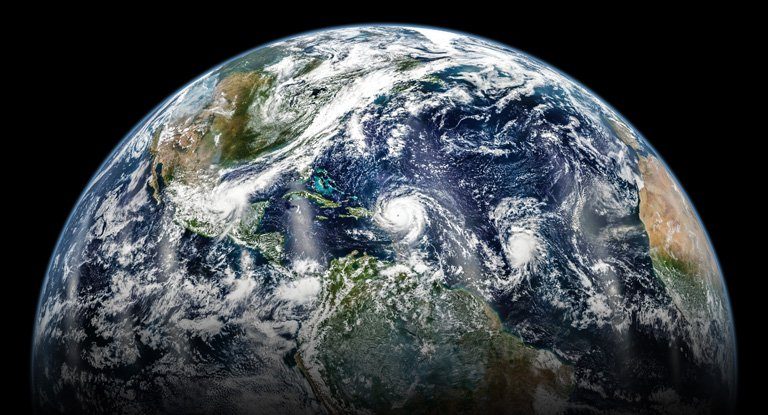
The world has changed irreversibly in the past 260 million years. Dinosaurs have come and gone; Pangea broke into the continents, islands, and seas we see today.
Earth has kept time through it all. According to research into ancient geological events, our planet’s geological activity is a steady ‘heartbeat.’ It occurs every 27 million years.
This pulsing of geological events, including mass extinctions, volcanic activity, plate reorganizations, and sea level increases, is extremely slow. It’s a 27.5 million-year cycle of catastrophes. Researchers believe we still have 20 million years to go before the next “pulse.”
In a statement released in 2021, Michael Rampino, the lead author of the study and a geologist at New York University, said that many geologists believed geological events were random over time.
Our study, however, provides statistical evidence of a common cycle that suggests these geologic events were not random but correlated.
The team analyzed the ages of 89 geological events that are well understood from the last 260 million years.
The graph below shows that some of these times were difficult – over eight world-changing events clustered together in geologically short time spans to form the catastrophic “pulse.” These events include marine and non-marine exterminations, major ocean-anoxic eruptions, continental flood basalt eruptions, and sea-level fluctuations.
“Our results suggest that global events are generally correlated and appear to come in pulses, with a underlying cycle of 27.5 million years.”
Scientists have studied a possible cycle of geological events for a very long time. In the 1920s and 1930s, scientists believed that geological records had a process of 30 million years. However, in the 1980s & 1990s, researchers based their estimates on the most recent geological events to determine the range between the ‘pulses.’
Everything is going according to plan – the 27.5 million year mark is about right. The same authors published a study in late 2020 that suggested this 27.5 million-year mark was when mass extinctions also occurred.
Alan Collins, a tectonic geologist from the University of Adelaide who was not involved in this study, said to ScienceAlert, “This paper is good, but I think that a better paper about this phenomenon [was] a 2018 paper by Muller and Dutkiewicz.”
Two researchers from the University of Sydney published a paper in 2018 that looked at Earth’s Carbon Cycle and Plate Tectonics. They also concluded that the cycle was approximately 26 million years in length.
Collins said that many of the events that the team studied are causal, meaning that they are directly related. For example, an anoxic event causes marine extinction.
He added that “this 26-30 billion year cyclicity seems to be real over a long period of time. It is also not clear what the underlying causes of it are!”
One space researcher has even suggested that Planet Nine may be to blame.
If Earth does indeed have a geologic “heartbeat,” it could be due to something closer to home.
The team’s study concluded that “These cyclic waves of tectonics and climate change could be paced either by geophysical processes associated with plate tectonics or mantle plumes. Or, they might be paced alternatively by astronomical cycle related to Earth’s movements in the Solar System and Galaxy.”