Scientists at the University of Leeds have made a ground-breaking discovery that could change the way scientists understand the largest and most common stars of the Universe.
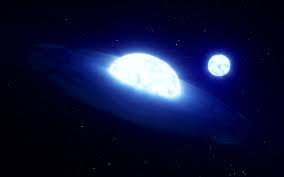
The research of Ph.D. student Jonathan Dodd and Prof. Rene Oudmaijer from the University’s School of Physics and Astronomy has revealed new and intriguing evidence that massive Be stars – which were previously thought to only exist in double stars, could be “triples.”
The discovery could change our understanding of these objects, a subset of B stars that are used as a “test bed” to develop theories about how stars evolve in general.
The Be stars are surrounded by a gas disc, similar to Saturn’s rings in our Solar System. Although Be stars are known to have existed for 150 years, they were first identified by the Italian astronomer Angelo Secchi back in 1866. However, until now, no one knew how they formed.
The astronomers have reached a consensus that the discs were formed by rapid rotation of Be stars. This can also be caused by stars interacting in binary systems.
Triple systems
Mr Dodd said, “The best reference point for this is if Star Wars. There are planets that have two Suns.”
Scientists have now found that by analyzing data collected from the European Space Agency Gaia satellite, they can prove these stars are actually triple systems, with three bodies interacting instead of two.
Mr Dodd continued: “We watched the stars as they moved across the sky over long periods, like ten years. We also observed them for shorter periods, around six months. If one star is moving in a straight direction, then we know it’s only one. But if there are more stars, we can see a wobble, or in the best cases, a spiral.
We applied this to the two groups of stars that we are examining – the Be and B stars – but what we found was confusing. At first, it looked like the Be stars had a lower companion rate than the B. It’s interesting because we would expect them to have higher rates.”
The principal investigator, Prof Oudmaijer, stated: “It is possible that they are too faint for us to detect.”
Mass Transfer
Researchers then looked at another set of data to find companion stars further away. They found that the rate of companion stars was very similar for both B and Be stars at larger separations.
They were able, from this, to deduce that, in many cases, a third star was at play. This forced the companion to move closer to the Be-star, close enough for mass to be transferred between the two and form the characteristic Be-star disc. It could also be the reason why we no longer see these companions; their size and brightness have decreased to the point that they are too faint to detect after being sucked into by the “vampire Be star.”
This discovery could have a huge impact on other areas of astronomy, including our understanding of black holes and neutron stars.
Prof Oudmaijer stated: “There is a revolution in physics right now around gravitational waves. These gravitational wave observations have only been made for a few short years. They have been proven to be caused by merging black holes.
These mysterious objects exist but don’t know anything about the stars that would eventually become them. Our findings give us a clue for understanding gravitational wave sources.”
He said: “In the past decade, astronomers discovered that binarity was an important factor in stellar evolution. Now, we are moving towards the idea that it’s even more complicated than that and that triple-stars need to be taken into consideration.
Oudmaijer stated that “triples are the new binaries.”
The team that made the discovery included Mr Dodd, a PhD student from Leeds, and Prof Oudmaijer. Also on the team were University of Leeds graduate student Isaac Radley as well as Dr Miguel Vioque of ALMA Observatory (Chile) and Dr Abigail Frost of European Southern Observatory (Chile). The team received funding through the Science and Technology Facilities Council.
The paper “Gaia unveils difference in B star binarity and Be star binaryity at smallscales: Evidence for mass transfer that causes the Be phenomenon” will be published in the journal Monthly Notices of Royal Astronomical Society on November 21 at 00.01 Universal Time Coordinated UTC.